New York school pauses robot-teacher pilot as lawmakers seek a ban
Salamanca City Central School District halted its planned fall Realbotix rollout while it works through student privacy terms and community concerns, and New York lawmakers responded with a bill to bar AI-enabled humanoid robots from instructional roles.
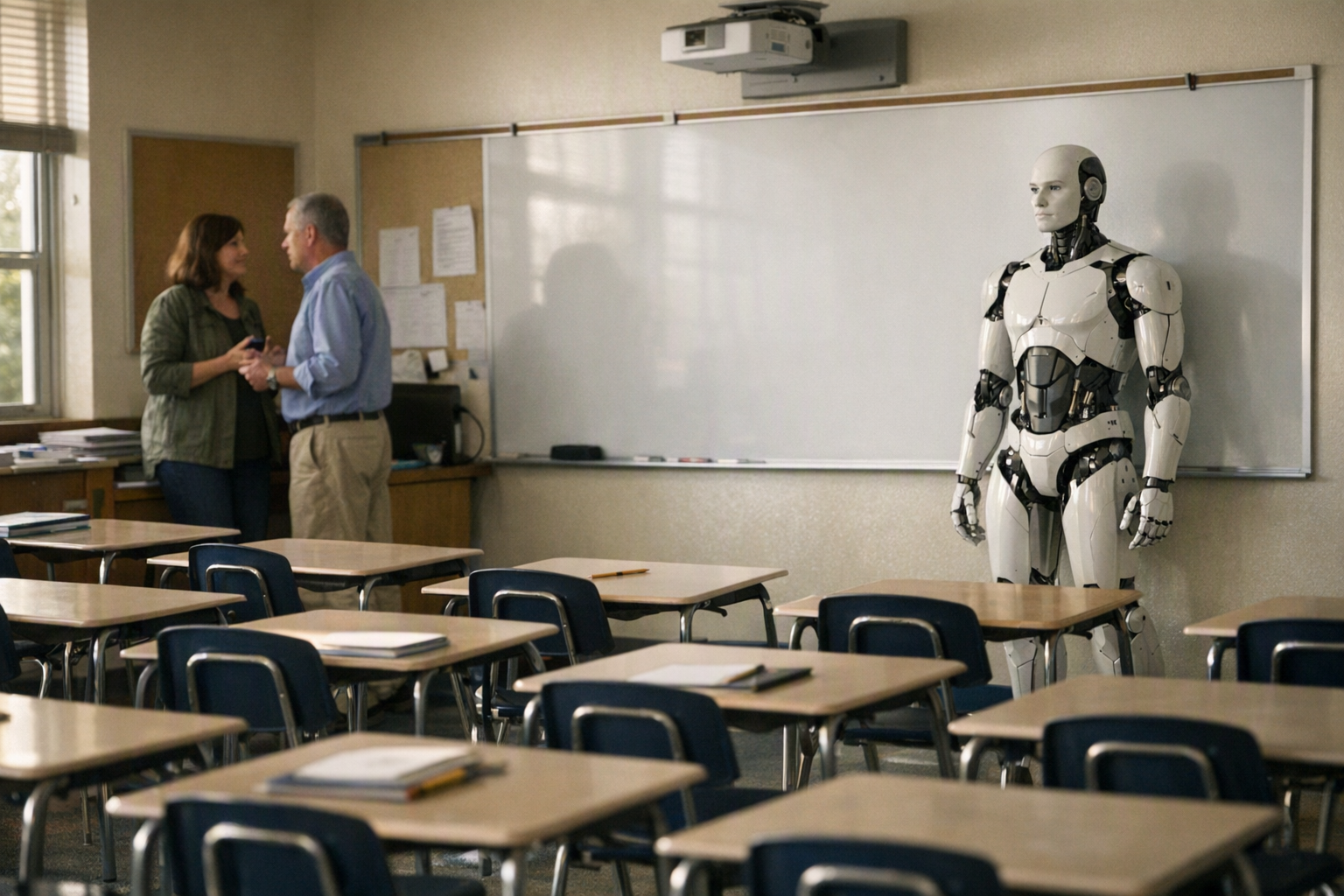
Salamanca City Central School District has put its planned Realbotix classroom pilot on hold, and New York lawmakers are now moving to keep AI-enabled humanoid robots out of instructional roles statewide. The western New York district announced the pause in a July 24 Facebook statement, saying it was working through enhanced student-data privacy agreements with the New York State Education Department and continuing community discussions. Five days later, state Sen. Shelley Mayer introduced [S10671], a bill that would require school systems to adopt humanoid-robot policies and would bar AI-enabled humanoid robots from serving in an instructional capacity. The speed of that turn matters: a product pitched as a bounded STEAM support tool is now a live test of how quickly school procurement can outrun policy. (btpm.org)
What changed is not that Salamanca suddenly discovered the product existed. The district had publicly announced the pilot on July 10, saying a small group of high school STEAM students and staff would use a Realbotix robot and digital avatar beginning this school year. In that launch post, Salamanca stressed that the system would use district-approved curriculum, would not record audio or video, would not collect personally identifiable information, would not transmit data to Realbotix, and would “never replace teachers, staff members, or meaningful human interaction.” The district also said the robot would not search the internet and would answer only from information intentionally loaded by the district. (salamancany.org)
But state officials were not satisfied with product framing alone. Reported coverage on July 24 and July 28 said Education Commissioner Betty Rosa warned Superintendent Mark Beehler that the department remained concerned about the effect of a humanoid robot in a high school classroom. Local and statewide reporting also said the district’s pause came before the planned fall rollout and while officials continued talking with community members and stakeholders. The district has not posted a new public launch date. The exact price is harder to pin down from primary documents: New York Focus reported the board-approved investment at $57,590, while Associated Press follow-ups described it as nearly $60,000. (wamc.org)
The real procurement question was never just the robot
For school leaders, the Salamanca story is less about whether a humanoid robot is “creepy” or exciting than about what districts must document before a vendor ever reaches students. New York’s student-privacy rules already require educational agencies contracting with third parties that receive student PII to include a data security and privacy plan, a Parents’ Bill of Rights, and minimum technical safeguards. NYSED has also warned districts that simply repeating statutory language is not enough; they must post contract-specific supplemental information, including what data is used and when an agreement expires. That is the governance gap exposed here: even when a district says a tool does not record, identify, or transmit student data, state reviewers may still want the claims translated into enforceable contract terms and a usable data map. That is analysis, but it is grounded in the district’s own launch claims and NYSED’s published compliance guidance. (nysed.gov)
Realbotix’s own education page helps explain why privacy review is not a box-checking exercise. The company markets Optio as “school-controlled AI” delivered through custom avatars and optional humanoid robots. It says the system uses teacher-approved content, does not use student interactions to train models, does not include facial recognition in the classroom robot, and does not build persistent individual profiles. At the same time, Realbotix says its avatar can adapt to each student’s language, comprehension level, and pace, and that authorized teachers can access student-specific insights. That is not necessarily a contradiction. But it does mean district leaders need a much more detailed answer than “the robot does not record” before they can explain to families, unions, and regulators what is collected, what is merely session-based, what counts as an insight, and who can see it. (realbotix.ai)
Salamanca’s local context raises the bar further. The district’s own Indian Policy and Procedures says it must consult with the Seneca Nation Education Department and parents of Indian children on general education programs and activities, and that the superintendent is to send copies of educational programs being added or eliminated at least five days before relevant meetings. That does not create a robot-specific rule. It does underscore that in some districts, AI purchasing is not only a tech-office decision or a board vote. It is also a community-relations and trust exercise, especially where schools operate within long-standing consultation frameworks. (salamancany.org)
The evidence case remains thinner than the marketing
Publicly available materials for Salamanca’s pilot emphasize support, engagement, and guardrails. They do not point to district-specific evidence that a humanoid robot delivers better learning outcomes than cheaper alternatives. Salamanca’s announcement described a locally bounded knowledge base and teacher support. Realbotix’s product page promises personalization, privacy controls, and teacher-approved content. Neither public document cites comparative classroom results for this product in this setting. That absence does not prove the product cannot help. It does mean districts are buying novelty and possibility before they can point to a mature evidence base for the exact implementation they are proposing. (salamancany.org)
The broader research literature is promising but conditional, not dispositive. A 2026 meta-analysis of 146 studies on social robots found that robots generally improved learning outcomes, especially when compared with no training at all. But the same study found wide variation by implementation: robots in a co-teaching role showed a strong positive effect, while robots replacing the teacher showed no benefit. That lines up neatly with both Salamanca’s public insistence that the robot would support rather than replace teachers and with lawmakers’ decision to target instructional capacity, not all educational technology. For buyers, the practical takeaway is simple: the best public evidence is for carefully bounded support roles, not for handing over core instruction. (frontiersin.org)
That distinction also explains why the legislative response is more consequential than it first appears. The operative text of S10671 defines an AI-enabled humanoid robot as a physical robotic device and bars such robots from delivering instruction, tutoring students, grading work, or otherwise performing duties ordinarily performed by certified staff. In other words, the bill’s legal core is narrower than its title, which also mentions AI avatars. For now, that leaves room for districts to keep exploring software-based AI tools, non-humanoid tutoring systems, or conventional robotics kits, subject to privacy law and local policy. But the direction of travel is tightening, not loosening: on July 31, Assembly bill A11662 was introduced with a broader approach that would prohibit schools from purchasing or deploying humanoid robots in instructional settings except for limited technical-study and demonstration uses. (legislation.nysenate.gov)
The implication for superintendents and cabinet teams planning fall AI pilots is not “never buy hardware.” It is “do the governance work before the unveiling.” That means tracing data flows in writing, clarifying what tasks remain teacher-only, stress-testing privacy agreements against state requirements, and deciding how parents, staff, and community partners will be briefed before students meet a machine with a face. Salamanca’s pause shows what happens when those steps are still in progress after a product has already been announced. What happens next will be worth watching on two fronts at once: whether the district revives any part of the Realbotix rollout, and whether Albany decides that the safest classroom rule is to keep humanoid instruction out altogether. (btpm.org)
More from School Leadership
Michigan reports another attendance gain and a clearer playbook for schools
Statewide attendance rose to 91.5% in 2025-26, while chronic absenteeism fell to 27.2%. The more useful news for school and district leaders is Michigan’s push to pair public data, early-warning routines, coaching, and family outreach tactics instead of relying on attendance messaging alone.

Texas study suggests special ed formulas miss much of district spending
Analyzing 6,116 Texas district-year observations, researchers found that placement and disability mix do track some special education costs, but explain only a modest share of spending differences, especially across smaller districts.
OpenAI expands ChatGPT for Teachers to 55 more districts
The bigger development for school leaders may be OpenAI’s 16-state National Data Privacy Agreement path, which could reduce contracting friction as districts move teacher AI use into managed, admin-controlled workspaces.