Wildfire smoke study finds many U.S. schools don’t protect indoor air well
A national analysis estimates smoke exposure at schools and childcare centers rose sharply from 2006 to 2023, giving districts firmer evidence for HEPA filters, PM2.5 monitoring, and stronger smoke-day plans.
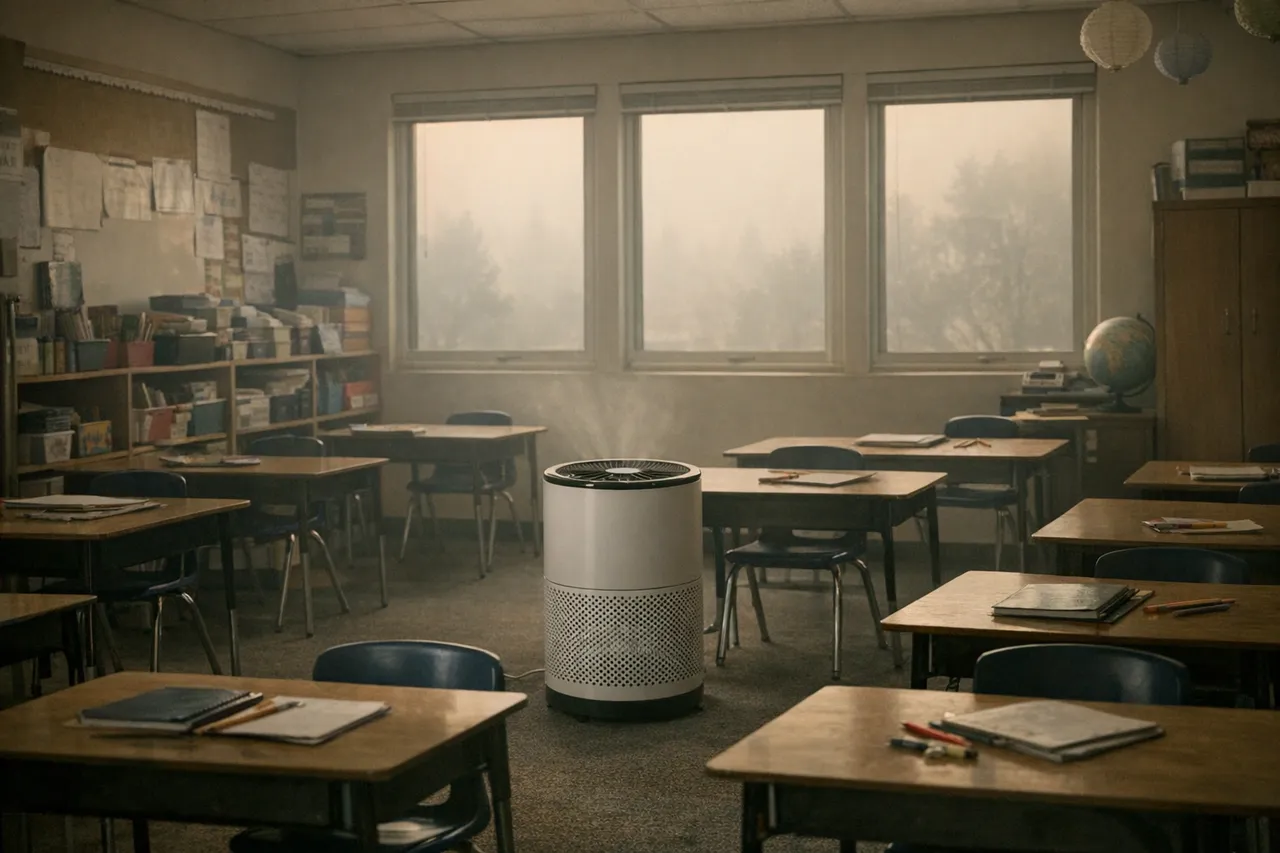
A study released Oct. 28 by Oregon State University researchers and published in Environmental Research gives school leaders a clearer answer on whether wildfire-smoke preparedness is worth scarce facilities money: yes, if the goal is to reduce real exposure rather than just move students inside and hope for the best. The researchers estimated smoke exposure at 115,612 U.S. public schools and 131,372 childcare centers from 2006 to 2023 and found that average annual smoke days rose from 6.8 to 54.4 at schools during the academic year and from 9.4 to 112.2 at childcare centers counted year-round. In 2023 alone, the paper reports 2.64 billion school student-smoke-days and 1.02 billion childcare student-smoke-days. (health.oregonstate.edu)
The practical takeaway is not simply that smoke is getting worse. It is that many buildings do not reliably solve the problem on their own. In the study’s smaller indoor-air sample of 71 West Coast facilities with nearby monitors, the median indoor-to-outdoor PM2.5 ratio during working hours was 0.86, meaning indoor air was often only modestly cleaner than outdoor air, and some sites measured worse than outdoors. That makes smoke planning less of a maintenance issue than an instructional-access issue: a district that closes windows but does not verify indoor air or add filtration may be interrupting school routines without substantially cutting exposure. (health.oregonstate.edu)
What this study measured — and what it did not
The paper describes itself as the first nationwide assessment of wildfire-smoke exposure in U.S. youth education settings. It is a modeling study, not a direct measurement campaign at every campus: the team combined national daily wildfire PM2.5 products with smoke-plume identification from satellite imagery and simulated air trajectories from fire locations. That matters for interpretation. The numbers are strong enough to show national trends, but they are still estimates, and the indoor-air findings come from a much smaller West Coast subset rather than a nationally representative building sample. (health.oregonstate.edu)
The study also complicates the usual “this is mainly a Western schools problem” narrative. The abstract says smoke-day counts were highest in the South and Midwest, while the West had the most severe days, a pattern consistent with smoke traveling far beyond fire zones. Childcare leaders should be especially careful with comparisons, though: the study counted childcare exposure year-round and school exposure during the academic year, so the two totals are not apples to apples. (health.oregonstate.edu)
What school systems should change before the next smoke wave
The research does not give districts a universal closure threshold, and it does not measure test scores, attendance, or direct learning loss. What it does provide is evidence that “stay inside” cannot be the whole plan. Federal guidance already points schools toward a more operational approach: the EPA says schools should check air quality daily and modify outdoor activity as conditions worsen, reducing longer and more intense activity on days that are unhealthy for sensitive groups, considering moving longer activities indoors or rescheduling them when air is unhealthy, and moving all activities indoors or rescheduling them when air is very unhealthy. EPA and ASHRAE guidance for schools and other public buildings also recommend smoke-readiness planning, indoor and outdoor PM2.5 sensing, higher-efficiency MERV-13 filtration where HVAC systems can handle it, and portable air cleaners as a way to reduce indoor smoke levels. (nepis.epa.gov)
That makes the likely order of operations clearer for budget season. For many districts, portable HEPA-type room cleaners and indoor/outdoor monitoring are the fastest way to turn a paper smoke plan into a measurable exposure-reduction plan, while larger HVAC and envelope upgrades remain capital projects. The Oregon State findings support that prioritization because they show wide variation in how well buildings protect children; ASHRAE’s guidance reinforces it by explicitly recommending both sensors and portable air cleaning, not just long-range renovations. (health.oregonstate.edu)
Sensor placement matters too. A 2024 study of four Washington schools found that during wildfire episodes, median hourly PM2.5 levels could vary by as much as 49.6 micrograms per cubic meter across locations inside a single facility, and indoor-to-outdoor ratios ranged from 0.22 to 0.91 across schools. In other words, one hallway sensor may not tell a principal what students are breathing in a classroom, library, or early-childhood room. That makes the new national paper more useful as a planning argument than as a substitute for local measurement. (stacks.cdc.gov)
Why this is becoming a learning issue, not just a facilities issue
The Oregon State study stops at exposure. But separate 2026 research in Environmental International linked wildfire smoke exposure in New York City public schools to higher same-day absence rates overall, with statistically significant effects in elementary and middle schools. That does not prove the same attendance effect everywhere, and it does not turn this new paper into an academic-outcomes study. It does, however, strengthen the case that smoke preparedness belongs in conversations about instructional continuity, not only building operations. (pubmed.ncbi.nlm.nih.gov)
For school leaders, the bigger shift is conceptual. Wildfire smoke is now common enough that a credible school plan needs more than a recess rule and a closure debate. It needs a way to know whether indoor air is actually better than outdoor air, a filtration strategy that can be deployed room by room, and activity protocols tied to real conditions. The districts and childcare providers worth watching before next fire season will be the ones that start treating clean indoor air as something students need to attend, concentrate, and stay well enough to learn. (health.oregonstate.edu)
More from School Leadership
Battle Ground voters approve school operations levy after three defeats
The unofficial Nov. 3 result gives Battle Ground Public Schools a three-year local revenue stream for 2027-29 after deep cuts and reserve use. The levy should stabilize planning, but it will not instantly restore positions or programs already cut from the current budget.

Douglas County’s attendance strategy uses weekly flags, home visits, and tutoring
Colorado says the district cut chronic absenteeism to 15.2% by linking dashboard alerts to school teams, family outreach, and a nine-week support program for students who need a reset.

NYC Public Schools’ AI tool list shows why districts must audit software features
A newly disclosed list of 38 flagged products shows that New York City’s AI rules often hinge on student-facing generative features, not entire apps. For school leaders, the bigger lesson is to ask vendors what AI is embedded, whether students can use it directly, and whether it can be turned off without disrupting instruction.