Science study backs phone-free classrooms, especially for struggling students
A large randomized trial in higher education found that enforced in-class phone collection modestly improved academic performance, with the biggest gains among lower-performing students. The result gives educators stronger evidence on classroom restrictions while stopping short of proving every schoolwide ban will work.
Science study gives phone-restriction advocates stronger evidence — and a more useful warning about design
A peer-reviewed Science paper published on October 8 adds unusually strong causal evidence to the classroom phone debate: in a randomized controlled trial spanning 16,683 students, 742 teachers, and 2,305 courses across 10 higher education institutions in Odisha, India, students in phone-free classrooms did better academically, with the biggest gains concentrated among lower-performing students. The paper’s official summary also says higher-performing students expressed support for the restriction after experiencing it. (pubmed.ncbi.nlm.nih.gov)
That matters because the study is not another correlation study or teacher survey. It is a preregistered field experiment, now peer-reviewed in Science, on a question that schools and colleges are actively trying to answer: does taking phones out of class actually change learning, or just signal adult frustration with student attention? The publication is also a milestone because versions of this research had circulated earlier as a 2025 SSRN working paper and a February 2026 Wharton summary; what is new this week is the paper’s appearance in one of the world’s top journals after peer review. (science.org)
The timing is hard to ignore. In the United States, NCES reported in February 2025 that 77% of public schools already prohibited student cellphone use during class. UNESCO said in March 2026 that 114 education systems worldwide now have national bans on mobile phones in schools. And in the past week, senators introduced a federal bill to support schools that restrict phones during instructional time, while Pew reported this summer that 77% of U.S. adults support in-class bans and 48% support all-day “bell-to-bell” bans. (ies.ed.gov)
What the experiment actually tested
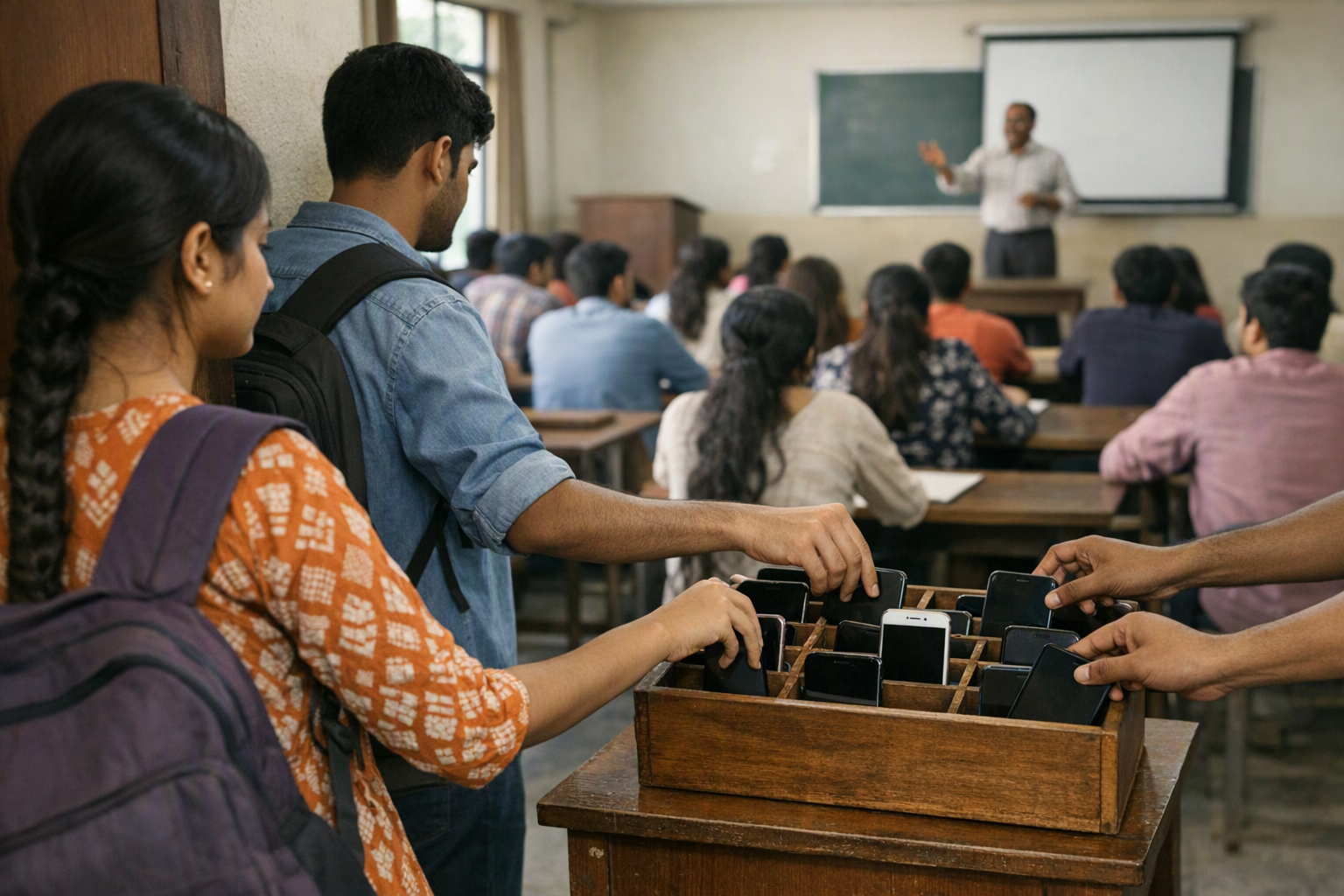
The intervention was more concrete than a generic “no phones” rule. Researchers said they installed roughly 1,000 wooden phone deposit boxes in classrooms across the partner institutions, stationed a full-time research assistant at each site, and worked with a designated teacher coordinator. In other words, the study tested enforced in-class phone collection as a routine, not merely a policy written in a handbook. (science.org)
That distinction matters for practitioners. A lot of school policies ask teachers to police phone use continually while still teaching. This experiment instead appears to have shifted the burden toward a predictable collection process at the start of class. That is one reason the findings are more useful than the usual culture-war version of the debate: they speak to an implementation model, not just a philosophy. This is an inference from the study design, but it is a practical one for school leaders deciding between “phones away,” “phones in bags,” and physically separated devices. (science.org)
In the prepublication working-paper version, the researchers reported that mandatory in-class phone collection raised grades by an average of 0.086 standard deviations, with stronger effects for lower-performing, first-year, and non-STEM students. The newly published Science version’s abstract and summary confirm the same headline pattern even where the brief public-facing excerpts do not restate every subgroup estimate: lower-performing students benefited most, and even higher-performing students became more supportive of the policy. (papers.ssrn.com)
The paper is also more restrained than some advocacy around school bans. The working-paper abstract reported no significant changes in overall well-being, academic motivation, digital usage, or online harassment, though it did find a mild rise in fear of missing out. At the same time, classroom spot checks found less chatter, fewer disruptive behaviors, less phone use, and greater teacher engagement. That combination suggests the gains likely came from a calmer instructional environment, not from a broad transformation of students’ lives outside class. (papers.ssrn.com)
Strong evidence, but not for every version of a ban
Educators should be careful not to overgeneralize. This was a higher-education study in one Indian state, not a K-12 bell-to-bell ban in the United States. It focused on classrooms, not hallways, lunch, or after-school time. That means the paper offers especially strong evidence for a narrower claim — enforced phone-free class time can improve academic performance — while leaving broader questions about whole-school restrictions, adolescent well-being, and long-term social effects more open. (science.org)
That caution is not abstract. Other recent studies point in different directions depending on the policy design and setting. An NBER working paper on Rio de Janeiro’s 2023 middle-school phone policy found that test scores improved by 0.06 standard deviations in schools newly exposed to the ban. But a separate large U.S. NBER paper on lockable phone pouches found that while pouch adoption reduced phone use, average effects on test scores were close to zero in the first year; disciplinary incidents initially rose, and student well-being appeared to dip before later recovering. (papers.ssrn.com)
Put together, those results suggest that “phone ban” is too blunt a category for serious decision-making. Age group, enforcement method, time horizon, and whether a policy is classroom-only or all-day all appear to shape outcomes. That is an inference from the emerging evidence base, but it fits what many educators already know from practice: removing a distraction is easier than rebuilding attention norms, and the latter usually comes with some short-term friction. (papers.ssrn.com)
The most important finding may be the equity one
For teachers, tutors, and academic support staff, the paper’s most actionable result may be who benefited most. If the biggest gains accrue to lower-performing students, then phone-free classroom design starts to look less like a blanket moral stance and more like an equity intervention. Students who are already struggling often have the least spare attention to lose; a policy that removes one steady source of cognitive interruption may help them more than it helps classmates who already have stronger study habits and more academic margin for error. That reading is analysis, but it is grounded in the study’s subgroup findings. (pubmed.ncbi.nlm.nih.gov)
The finding that higher-performing students also came to support the restriction is nearly as important. Policy fights over phones often assume the trade-off is obvious to adults but illegible to students. This study suggests at least some students may revise their views after experiencing a more focused classroom. For colleges in particular, that weakens the common objection that adult learners will uniformly reject structured limits on device access. (pubmed.ncbi.nlm.nih.gov)
What schools should not take from the paper is that any anti-phone measure will work. The experiment did not test a teacher repeatedly asking students to keep phones in backpacks while notifications still buzz. It tested separation. For administrators, that points toward a more practical policy question than “ban or not”: where are phones stored, who handles exceptions, how much enforcement falls on teachers, and how much early disruption is a school prepared to absorb while routines settle? Those questions also help explain why U.S. pouch studies and classroom-collection studies can produce different patterns. (science.org)
The new Science paper will not end the debate over student devices. It does, however, move the discussion onto firmer ground. Educators now have one more large, randomized, peer-reviewed study showing that taking phones out of class can modestly improve academic outcomes — especially for students who have the most to gain. The next question worth watching is whether U.S. schools and colleges translate that evidence into classroom routines that are enforceable, targeted, and honest about the trade-offs, rather than into slogans that overpromise. (pubmed.ncbi.nlm.nih.gov)
More from Research & Evidence
Pre-K review says much of the evidence base is weaker than it looks
An August 2026 working paper reviewing 120 reports on state and local pre-K says many studies used comparison groups too weak for strong causal claims. In longer-term achievement results, randomized evaluations were more likely than other designs to point in a negative direction.

Oregon packages K-1 math intervention evidence for schools
A new University of Oregon summary of 112 studies, plus an implementation guide, gives K-1 teams a practical tool for choosing Tier 2 and Tier 3 numeracy support before fall plans lock in.

Ohio study finds modest reading gains near third-grade retention cutoff
A July 2026 working paper found that students just below Ohio’s Grade 3 reading threshold made larger ELA gains than similar peers just above it, with smaller positive effects lasting through Grade 7. The biggest effects appeared where schools had both accountability pressure and capacity to add targeted supports.