Pre-K review says much of the evidence base is weaker than it looks
An August 2026 working paper reviewing 120 reports on state and local pre-K says many studies used comparison groups too weak for strong causal claims. In longer-term achievement results, randomized evaluations were more likely than other designs to point in a negative direction.
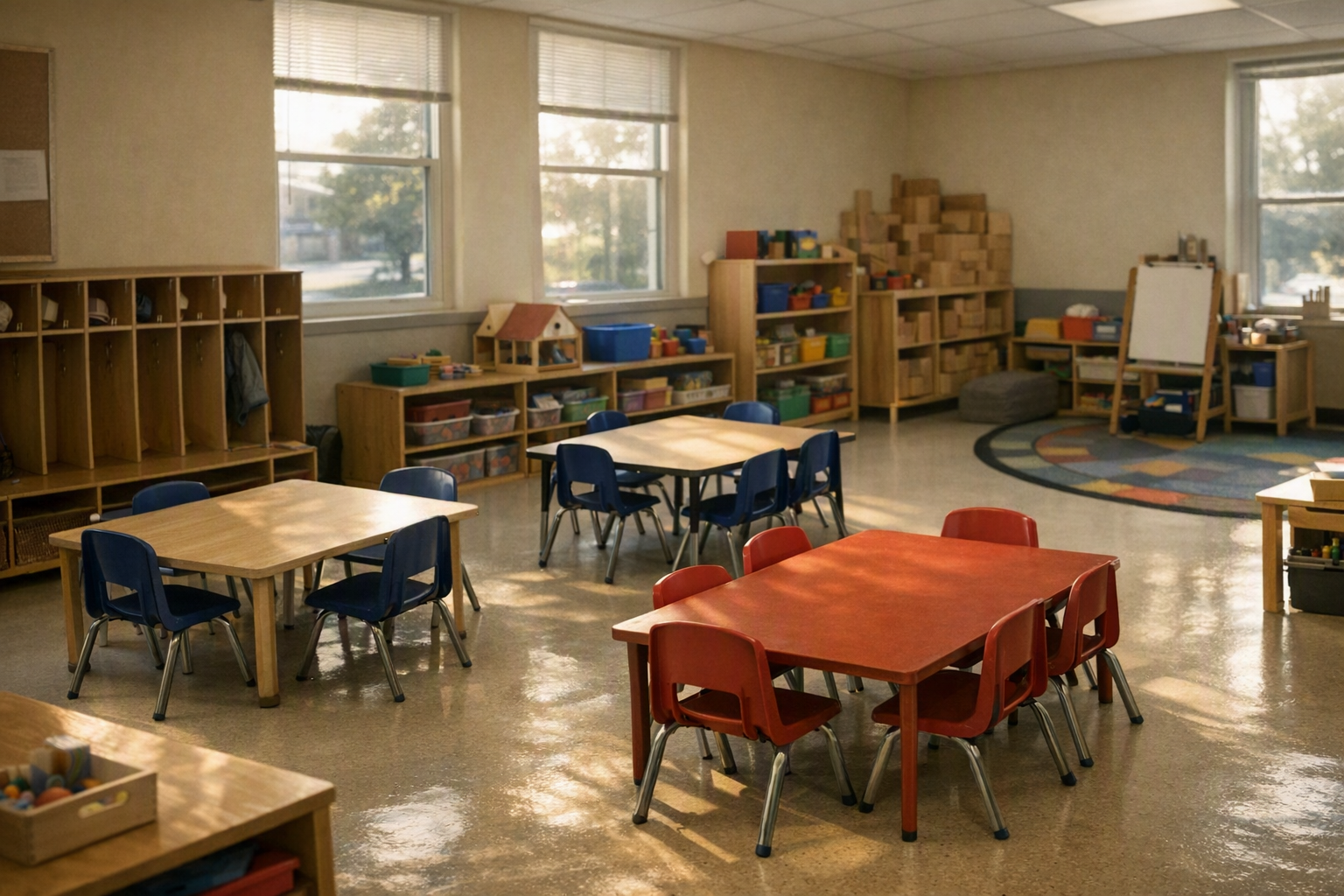
A new EdWorkingPaper review of state- and locally funded pre-K evaluations is challenging one of the safest assumptions in education policy: that the evidence for public preschool is broad, consistent, and causally strong. Reviewing 120 evaluation reports from 91 studies conducted between 2000 and 2021, the authors found that most did not use comparison groups strong enough to support firm causal claims. And when they looked specifically at longer-term achievement results from randomized evaluations, 65% of those estimates were negative in direction. The paper was posted in August 2026, and like other papers on the EdWorkingPapers platform, it has not yet gone through formal peer review.
That matters because states are still building and defending large pre-K systems. NIEER’s latest yearbook says state-funded preschool reached record highs in spending and enrollment in the 2024-25 school year, with nearly 1.8 million children enrolled and most states operating some form of mixed-delivery system across districts, child care centers, Head Start, and sometimes family child care. At the same time, a recent NIEER design brief warns that large public preschool systems have produced highly variable results and that intentional evaluation design is necessary if policymakers want confidence about what is working. (nieer.org)
For district leaders and state officials, the new paper is best read as an audit of the evidence base, not as a clean yes-or-no verdict on preschool itself. The authors do not present one new statewide impact estimate. Instead, they sort studies by research design and by the direction of reported findings. That distinction is crucial: a literature can look persuasive in the aggregate and still be methodologically uneven when leaders ask the harder question, How sure are we that pre-K itself caused the result? (edworkingpapers.com)
Strong early gains, shakier long-term claims
The headline finding is easy to oversimplify. Across research designs, achievement findings measured at the end of pre-K were overwhelmingly positive. That fits what many educators see on the ground: children often arrive in kindergarten with stronger early literacy, language, or math skills after a year in a structured program. But the review says those short-term gains appear in studies of many different quality levels, including weaker designs. Longer-term achievement is where design starts to matter much more. There, randomized evaluations were substantially more likely than other designs to point in a negative direction. (edworkingpapers.com)
That does not mean every rigorous study says public pre-K hurts children, or that the negative estimates were all large. Some of the strongest evidence is mixed rather than uniformly bleak. A lottery-based long-term study of Boston pre-K found boosts to college attendance, SAT-taking, and high school graduation, along with reductions in disciplinary outcomes, even while finding no detectable effect on state test scores. But the Tennessee Voluntary Pre-K study found that children randomly assigned to attend had lower achievement scores in grades 3 through 6 than the control group, and a Georgia pre-K lottery study found kindergarten-entry gains that faded, with some negative achievement effects emerging by grade 4. The practical lesson is not that one side of the preschool debate has finally won. It is that leaders should stop talking as if all “rigorous evidence” points the same way. (nber.org)
This review also lands in the middle of an active scholarly argument. A 2024 Science policy forum, written by several of the same researchers involved in the new review, argued that recent rigorous studies justify more caution about the longer-run effects of modern early education programs. A response from James Heckman and Jorge Luis Garcia said that view underweights evidence from influential earlier programs such as Perry Preschool and Abecedarian and gives too much weight to what they see as flawed modern evaluations. Readers should understand the August 2026 paper in that context: it is not a neutral closing statement on the field, but an extension of a larger methodological dispute about which studies deserve the most policy weight.
Why comparison groups are the real story
The most useful part of the paper may be its focus on comparison groups. When the authors say many studies lacked “internally valid comparisons,” they are pointing to a basic problem in education evaluation: children who enroll in pre-K are often different from children who do not, and the alternatives available to non-attenders can be very different too. If one group has more family resources, more motivated parents, or access to better private child care, a simple pre-K versus no-pre-K comparison can easily misstate the program’s true effect. That is why oversubscribed lotteries and randomized assignments carry so much weight in this literature. (edworkingpapers.com)
This is also why leaders should be careful not to overread either positive or negative studies. North Carolina research, for example, has found positive long-term associations between NC Pre-K funding and later reading and math achievement through eighth grade, using large administrative datasets and county-level variation in funding. That is important evidence. But it is not the same kind of evidence as a seat lottery or wait-list randomization, and the 2026 review’s central claim is precisely that these design differences matter when policymakers make causal claims. In other words, the paper is strongest as a critique of how the field talks about evidence, not as a blanket judgment on every pre-K classroom in every state. (dukespace.lib.duke.edu)
A second reason the newer evidence can look weaker is that the counterfactual has changed. In an earlier working paper on why preschool programs may appear less effective than older demonstration projects, several of the same scholars argued that modern programs are often being compared not with children staying home in low-stimulation settings, but with children who already have access to other center-based care or better early-learning environments than was common decades ago. If that is right, then a smaller measured achievement effect does not necessarily mean a public pre-K system offers no value. It may mean the program is competing against a stronger baseline and that its benefits could show up in access, family stability, attendance, behavior, or later attainment rather than only in elementary test scores. That is analysis, but it is analysis grounded in the direction of the recent research.
What school and state leaders should ask now
The serviceable takeaway for practitioners is straightforward. Before citing a pre-K study in a board meeting, state hearing, or expansion plan, ask four questions. Who exactly were the comparison children? How were they selected? How long were children followed? And which outcomes were counted? A study showing strong gains at kindergarten entry may still tell you very little about grade 3 reading, student behavior, special education placement, attendance, or later graduation. NIEER’s 2025 brief makes a similar point from a different angle: big public preschool systems can produce very different outcomes, so evaluation design has to be intentional if leaders want results they can trust. (nieer.org)
That has operational consequences. Districts expanding mixed-delivery pre-K should build evaluation plans before scaling, not after. States should track community-based providers and family child care settings in the same data systems they use for district classrooms. And advocates should be more disciplined about separating three claims that are often blurred together: that pre-K expands child care access, that families value it, and that a particular program produces lasting academic benefits. All three can matter, but they are not the same claim and they do not require the same evidence. (nieer.org)
As states continue to add seats and money to preschool, the most important shift may be rhetorical as much as technical. The real question is no longer whether pre-K is an article of faith for supporters or a target for skeptics. It is whether leaders are willing to demand evidence strong enough to tell the difference between a popular program, a useful child care investment, and a classroom model that truly changes children’s later trajectories. The August 2026 review argues that, in much of the state and local literature, that line is still blurrier than advocates usually admit. (nieer.org)
More from Research & Evidence

Science study backs phone-free classrooms, especially for struggling students
A large randomized trial in higher education found that enforced in-class phone collection modestly improved academic performance, with the biggest gains among lower-performing students. The result gives educators stronger evidence on classroom restrictions while stopping short of proving every schoolwide ban will work.

Oregon packages K-1 math intervention evidence for schools
A new University of Oregon summary of 112 studies, plus an implementation guide, gives K-1 teams a practical tool for choosing Tier 2 and Tier 3 numeracy support before fall plans lock in.

Ohio study finds modest reading gains near third-grade retention cutoff
A July 2026 working paper found that students just below Ohio’s Grade 3 reading threshold made larger ELA gains than similar peers just above it, with smaller positive effects lasting through Grade 7. The biggest effects appeared where schools had both accountability pressure and capacity to add targeted supports.