Houston ISD’s gains face a harder test: budget cuts as enrollment falls
Houston ISD says its state-led turnaround sharply improved school ratings and raised teacher pay. But September campus cuts, school closures and continued enrollment losses now put the model’s long-term cost and transferability under closer scrutiny.
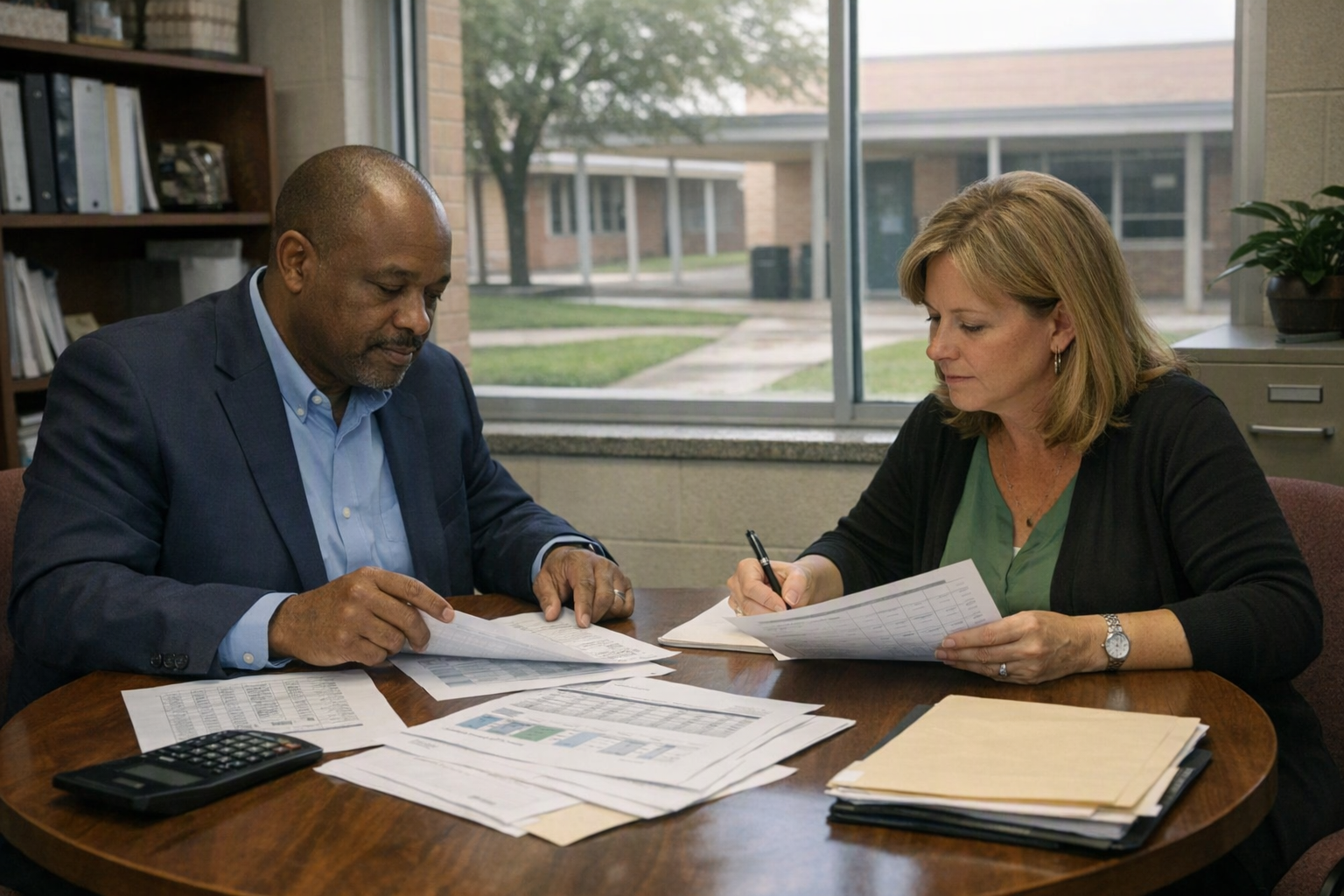
Houston ISD’s state-led turnaround reached a new and more concrete tradeoff this week: the district that has spent three years touting stronger academic ratings, higher teacher pay and tighter classroom systems is now cutting staff and spending at some campuses after enrollment fell further than expected. On Sept. 23, the district told schools to make reductions as part of annual campus leveling tied to actual enrollment; on Sept. 25, it defended the move as necessary to keep spending aligned with revenue and said it still holds an estimated fund balance of about $730 million. What the district still has not said publicly is how many campuses, positions or dollars are affected. (texastribune.org)
For superintendents and principals elsewhere, Houston is becoming less a simple proxy war over state takeovers and more a practice case in implementation math. District officials say the number of A- and B-rated schools rose from 93 in 2023 to 205 in 2026, while D- and F-rated schools fell from 120 to 13 and average teacher salary rose by $15,000. But a Texas Tribune investigation, republished by The Hechinger Report, found that at roughly half of Houston’s campuses the New Education System, or NES, has cost about $700,000 more per school and about $2,200 more per student, while the district has lost 21,000 students and about $190 million in state funding since the takeover began. (houstonisd.org)
What the turnaround bought
The Houston model is not hard to describe. The challenge is paying for it at scale. HISD says NES is built around aligned curriculum, clear instructional expectations, ongoing coaching and added classroom capacity so teachers can focus more deeply on instruction. The district also says NES campuses posted the strongest academic gains on state tests from 2023 to 2026, with students at those campuses improving by an average of 15 percentage points in meeting grade-level standards in math and reading, compared with about 4 points at non-NES campuses. (hisdnow.houstonisd.org)
Outside reporting has put human detail around that model. At Fonville Middle School, the Tribune and Hechinger described a campus that added learning coaches, classroom technology and a longer school day, then moved from an F before the takeover to an A this year. That matters because Houston’s gains are not just district-office abstractions; they show up in campuses that historically served students from low-income neighborhoods and had struggled for years under the old system. The Texas Education Agency’s 2026 accountability portal now lists Houston ISD as a B-rated district overall. (hechingerreport.org)
That is the strongest argument for the Houston approach, and it is stronger than many critics sometimes allow. Intensive coaching, tighter lesson design, more classroom support and better pay can produce visible academic movement, especially in schools that had been chronically low-performing. The district also says it has shifted spending toward instruction and instructional leadership, from 57% of the budget in 2023 to 72% in 2026. In other words, the system did not improve by doing the same work more efficiently; it improved by buying a more intervention-heavy version of school. (houstonisd.org)
When enrollment turns into cuts
The problem is that those interventions are recurring costs in a district funded largely by attendance. HISD acknowledged in April that student enrollment had fallen by about 16% in recent years while staffing had declined by only about 5%. When a district keeps more adults, higher salaries and more campus supports while students leave faster than projected, the squeeze eventually shows up somewhere. This week it showed up in campus budgets. District officials characterized the reductions as routine leveling, but the Sept. 23 reporting made clear that schools were being told to cut in the middle of the semester because this year’s losses came in steeper than expected. (hisdnow.houstonisd.org)
The district’s own explanation is only partly about takeover politics. HISD has pointed to broader revenue pressure, enrollment change and an unfriendly state funding climate. A separate Rice University Kinder Institute brief on Houston-area demographics supports at least part of that case, finding stagnating birth rates, an aging population and school choice patterns that complicate enrollment forecasting for urban-core districts. HISD has echoed that argument, saying the number of school-aged children in several attendance zones has fallen even as population patterns inside district boundaries shift. (hisdnow.houstonisd.org)
But demographics do not settle the whole question. A University of Houston analysis released in January found that HISD’s enrollment losses accelerated after the 2023 takeover and that the district was serving 13,208 fewer students in 2024-25 than in 2022-23, alongside higher shares of first-year and uncertified teachers and lower retention of experienced educators. That does not prove the NES model alone pushed families out; it does show why district leaders elsewhere should be careful about claiming that enrollment decline is either entirely structural or entirely self-inflicted. In Houston, both explanations have evidence behind them. (uh.edu)
The immediate school-level consequence is easy to picture. If a district promises more adults in buildings, richer supports and protected core instruction, late enrollment corrections are likely to land on the remaining flexible parts of a campus budget: electives, extra sections, discretionary spending and nonmandated programs. The Tribune reported that Lamar High School’s principal told families the school faced a $500,000 shortfall that would affect choir and debate. That example is specific to one campus, but it illustrates the broader leadership tradeoff. A reform can raise systemwide ratings and still narrow what some individual schools are able to offer in-year. (texastribune.org)
The part other districts should price first
Houston’s experience suggests a lesson that goes beyond Texas. Turnaround plans are often sold politically as governance fixes, accountability resets or culture changes. In practice, they are also spending choices. Houston has already used reserves heavily; the Tribune reported the district pulled nearly $450 million from rainy-day funds in the first two years of the takeover. Even with a still-large fund balance, reserves buy time, not a permanent answer. If enrollment keeps dropping, leaders eventually have only a few levers left: shrink the model, close or consolidate schools, find new outside money, or accept recurring cuts elsewhere. (texastribune.org)
Houston has already moved on one of those levers. In February, HISD announced 12 school closures and consolidations for 2026-27, citing underutilization and aging facilities. That means the September leveling cuts are not an isolated budget event; they sit inside a larger district effort to reconcile a more expensive instructional model with a smaller student body. And even now, the district is still expanding NES to nine more elementary campuses this school year, a sign that district leaders remain convinced the academic case for the model outweighs the financial risk. (hisdnow.houstonisd.org)
The unresolved question, then, is no longer whether Houston can post better ratings under a hard-edged turnaround. By 2026, it clearly has. The question is whether those gains can remain durable when the same system that paid for coaching, longer days, higher compensation and classroom technology must also absorb enrollment loss, campus closures and midyear cuts without eroding family confidence further. That is the part of the Houston playbook other districts should study before they copy the visible pieces. (houstonisd.org)
More from School Leadership

Michigan reports another attendance gain and a clearer playbook for schools
Statewide attendance rose to 91.5% in 2025-26, while chronic absenteeism fell to 27.2%. The more useful news for school and district leaders is Michigan’s push to pair public data, early-warning routines, coaching, and family outreach tactics instead of relying on attendance messaging alone.

Texas study suggests special ed formulas miss much of district spending
Analyzing 6,116 Texas district-year observations, researchers found that placement and disability mix do track some special education costs, but explain only a modest share of spending differences, especially across smaller districts.

OpenAI expands ChatGPT for Teachers to 55 more districts
The bigger development for school leaders may be OpenAI’s 16-state National Data Privacy Agreement path, which could reduce contracting friction as districts move teacher AI use into managed, admin-controlled workspaces.