Florida adopts statewide AI rules for schools and state colleges
Florida’s new framework requires local AI policies, parent notice and non-AI alternatives for some classroom uses, and explicit limits on companion-style tools and student-data practices ahead of the 2027-28 school year.
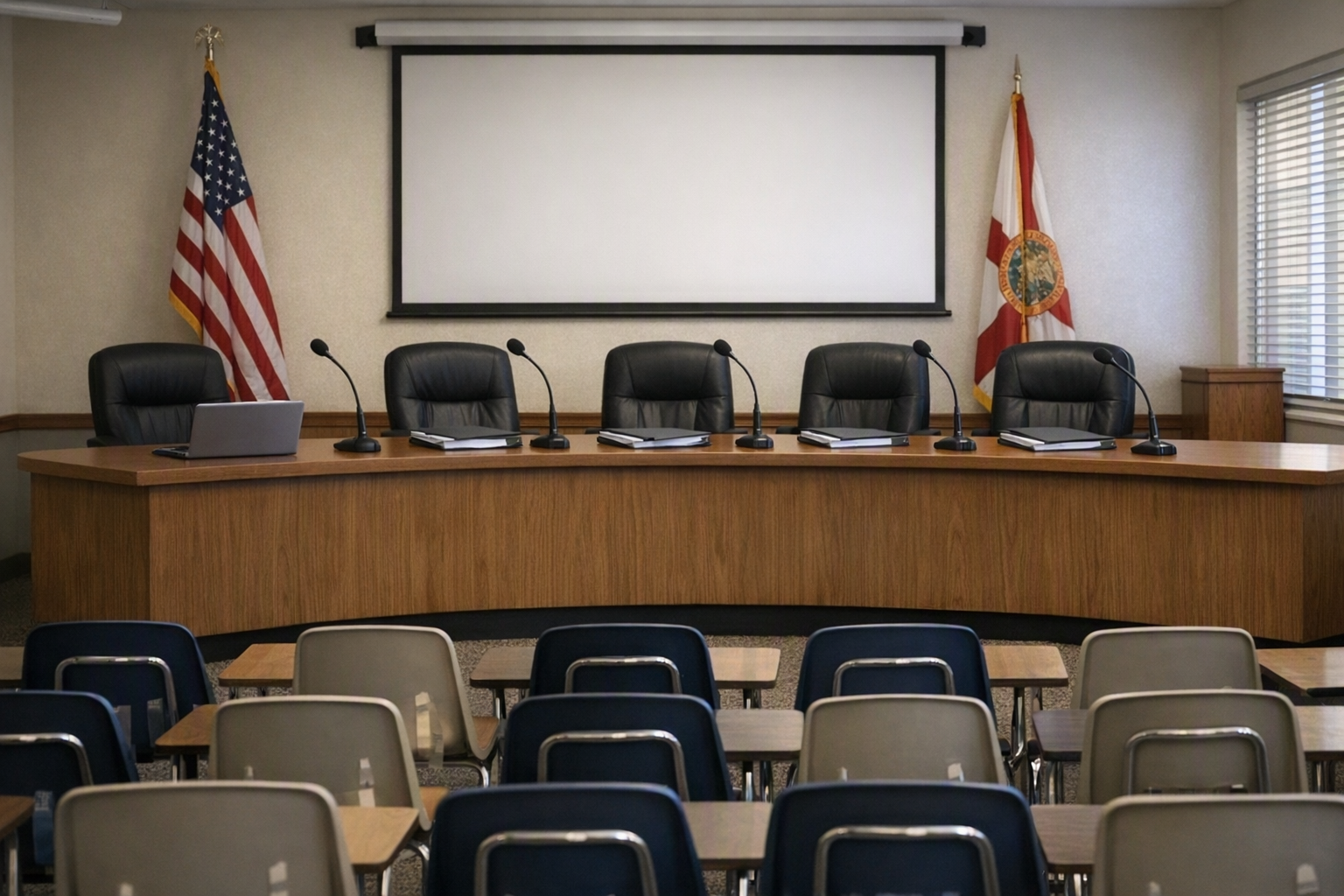
Florida’s State Board of Education on Sept. 16 adopted new statewide rules for artificial intelligence in public education, requiring school districts and charter school boards to rewrite local internet-safety policies and requiring Florida College System institutions to adopt campus AI policies. For K-12, the rules add parent notice and parent choice when approved AI instructional tools are used with students, while state colleges now have to set explicit limits on academic use of AI. (fldoe.org)
The change reaches a large swath of Florida’s public system. The Department of Education says it serves nearly 2.8 million students across roughly 4,400 public schools and 28 colleges, and the Florida College System confirms those 28 institutions are under the State Board’s jurisdiction. Public school districts and charter boards have until July 1, 2027, to adopt and implement the K-12 policy changes for the 2027-28 school year; the state’s public materials reviewed for this story are clearer on that K-12 deadline than on a single matching date for every college campus, but the college rule now requires boards of trustees to write local policies as well. (fldoe.org)
What is still unsettled is less the state’s direction than the mechanics. The Board created a statewide floor, not a single statewide operating manual: districts still have to decide how they will vet tools, notify families, document parent choices, provide non-AI alternatives, train staff, and monitor compliance. And the rules do not cover Florida’s 12 public universities, which are on a separate track under the Board of Governors. That board published a Sept. 3 notice proposing syllabus-level disclosure of faculty and student AI use, a narrower approach than the K-12 and state-college rules adopted Wednesday. (fldoe.org)
From classroom experiments to compliance work
For school districts and charter boards, the most immediate shift is that AI is no longer just a teacher-practice issue or a district tech memo. It is now embedded in Rule 6A-1.0957, Florida’s internet-safety policy rule. The department said local policies must, at minimum, tell parents when an AI instructional tool is approved, identify the tool and the courses involved, explain how students will interact with it, give families the choice of allowing use or receiving a non-AI alternative, and subject VPK-through-grade-5 tools to extra review for age and developmental appropriateness. The state also said the rules ban AI designed to meet students’ social or emotional needs, simulate companionship or emotional relationships, or use anthropomorphic design to pull students into longer interactions. (fldoe.org)
The policy goes beyond notice and consent. State materials and News Service of Florida reporting say the K-12 rules also prohibit undisclosed behavior monitoring, social scoring, psychological profiling, and vendor sale of student data or its use to train agentic models. They also require teacher and administrator training on AI risks, limitations, safety, and legal compliance. In practice, that means the hardest work for many districts may not be deciding whether AI is allowed in principle, but building a repeatable approval process that can survive procurement renewals, parent questions, and classroom edge cases. (fldoe.org)
That training piece matters because schools are trying to govern technology that many educators are already using, often with little formal guidance. A Gallup and Walton Family Foundation survey released in May found that only 18% of U.S. K-12 teachers reported receiving any formal guidance on how AI tools should be used at work. Florida’s new rules will not solve that gap by themselves, but they do force districts to move AI from informal habit to documented policy, which should matter for principals, instructional coaches, and IT leaders who have been improvising. (news.gallup.com)
The tradeoff is administrative load. In comments submitted during rulemaking, the Software and Information Industry Association argued that Florida’s draft defined AI so broadly that it could sweep in lower-risk, purpose-built instructional products alongside open-ended chatbots, and warned that notification, opt-in, and alternative-assignment requirements could burden schools and cut some students off from useful adaptive tools. Florida’s adopted approach clearly favors parent control and risk reduction over a lighter-touch model, especially for younger students. Whether districts can preserve access to beneficial tools while honoring those guardrails will be one of the real implementation tests. (siia.net)
State colleges get fewer pages of rules, but a sharper integrity line
The college rule is narrower in day-to-day classroom procedure but blunter on academic integrity. Reporting on the adopted rule says Florida’s 28 state colleges must now adopt AI policies covering students, staff, and campus guests, with policies addressing academic integrity, course assignments, and grading. Those policies must prohibit students from using AI on graded assignments or assessments unless an instructor explicitly allows it. The department’s Sept. 16 announcement also said the new framework applies to public-school students who are dual enrolled at Florida colleges, an important detail in a state where dual enrollment is a major pathway into higher education. (news.wfsu.org)
That college-side design leaves more discretion with institutions and instructors than the K-12 rule does, but it also raises a practical burden for faculty: they will have to say much more clearly when AI is allowed, when it is not, and what counts as acceptable assistance. Some campuses are ahead of the state. Spectrum News reported before the vote that Seminole State College had already convened an AI task force, adopted an institutional policy, and expanded faculty professional development around AI. Other colleges are likely to be much earlier in the process, which means the statewide rule may function less as a culture shift than as a forcing mechanism for campuses that have not yet turned informal guidance into board-approved policy. (mynews13.com)
Broader than many states, but not the whole system
Florida is not the first state to require local AI policies. K-12 Dive reported this summer that Idaho, Maryland, Oklahoma, Virginia, Ohio, and Tennessee had already moved beyond guidance-only approaches and required districts to adopt AI policies. What makes Florida’s package more consequential is its scope and specificity: it spans both K-12 and the Florida College System, pairs parent choice with non-AI alternatives, and writes explicit bans on companion-style AI and certain student-data practices into state policy. That is a more operational model than simply telling districts to “have an AI policy.” (k12dive.com)
It also reflects a route Florida took after legislation stalled. A 2026 Senate bill focused specifically on artificial intelligence in education, which would have required statewide AI standards and teacher training, died in committee in March. The broader Artificial Intelligence Bill of Rights also died in messages in the House. The Board’s Sept. 16 action shows the administration using existing regulatory authority to set rules for the systems it directly governs, even as the state’s universities remain on a separate, still-developing policy path. (flsenate.gov)
For district leaders and college administrators, the useful question now is not whether Florida is “for” or “against” AI. The state has answered that: AI can stay, but only inside tighter rules. The next question is whether local systems can turn those rules into something workable before families start asking which tools are approved, teachers start rewriting assignments and syllabi, and boards start weighing contracts that now have to satisfy both instructional goals and a much more demanding compliance test. The next documents worth watching are the codified rule text and the first wave of district and college policies that show how Florida’s statewide guardrails will actually land in classrooms. (fldoe.org)
More from EdTech & AI

NYC schools bar student-facing AI through middle school, limit high school use
The 2026–27 policy also sets daily 1:1 device caps for younger students, preserves disability and language-access exceptions, and lets staff use approved AI tools for planning but not grading or student decisions.

Microsoft and teachers unions launch AI contract standard for schools
The new framework lets districts add AI privacy and safety protections to Microsoft agreements, including limits on student data use, tracking, and automated decision-making. But the protections are not automatic: schools must request them and review the final contract language closely.
Anthropic brings Claude for Teachers to U.S. school districts for free
The new rollout turns Claude for Teachers into a centrally managed district service with SSO, role-based controls, domain capture, and K-12 privacy terms. It is built for educator use, not student accounts, and leaves renewal pricing unanswered after the free year.