NYC schools bar student-facing AI through middle school, limit high school use
The 2026–27 policy also sets daily 1:1 device caps for younger students, preserves disability and language-access exceptions, and lets staff use approved AI tools for planning but not grading or student decisions.
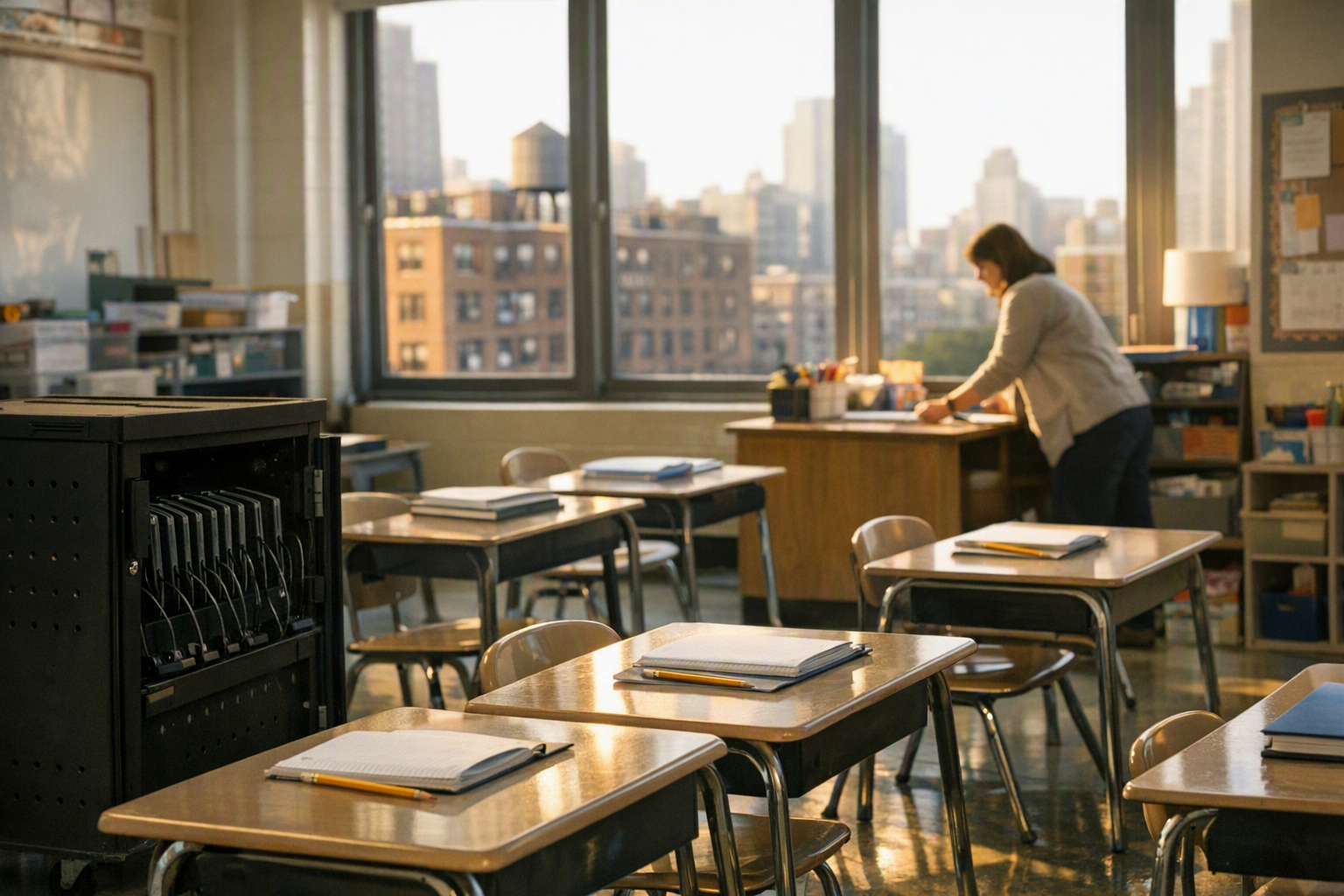
New York City Public Schools opened the 2026–27 year with one of the clearest district playbooks yet for limiting classroom AI: a moratorium on student-facing generative AI for younger students, daily caps on routine 1:1 device time through middle school, and only tightly bounded pilot use for high schoolers. Families were told about the policy as schools reopened on September 10, 2026, and the district says the rules apply this school year. (schools.nyc.gov)
The headline is not a blanket AI ban. NYCPS says the student restrictions apply specifically to generative AI, while staff may continue using approved AI tools for instructional planning and operational work. The district also carved out accessibility and language-access exceptions, saying the screen-time and AI restrictions do not apply to assistive technology in a student’s IEP or 504 Plan or to technology required for English Language Learners under federal and state mandates. (schools.nyc.gov)
What changed from spring to fall is important. In March, the district released its first AI guidance for educators and school leaders, built around academic integrity, student privacy, data security, and human judgment, and opened a feedback window through May 8. The September rollout turned that earlier guidance into a family-facing, school-year operating policy with age-banded student rules, explicit screen-time limits, and a promise that a Technology in Schools Coalition will help shape whatever comes next in 2027–28. (schools.nyc.gov)
Split the student rules from the staff rules
The most transferable part of NYC’s approach is not the phrase “moratorium.” It is the district’s decision to separate student-facing AI from adult use and to write different rules for each. For younger students—described by the district as grades 2-K through 8, covering early childhood through middle school—student-facing generative AI is off limits as part of learning this year. For grades 9 through 12, student-facing AI is limited to carefully controlled pilots using five vetted and approved programs, with additional supervised use allowed in career-readiness settings such as Career and Technical Education. The district also says every high school student will complete AI literacy coursework. (schools.nyc.gov)
That structure gets at a problem many districts have struggled to solve since generative AI tools exploded into schools: broad principles are easy to publish, but much harder to operationalize when the same tool might be used by a teacher planning tomorrow’s lesson, by a student trying to draft an essay, or by a system making judgments about a child. NYCPS tries to solve that by naming the classroom actors separately. Students get developmental limits. Teachers keep some approved productivity uses. And the district draws a firm line around high-stakes student decisions, saying AI may not be used for grading, behavior monitoring, or placement, promotion, graduation, and similar decisions about students. (schools.nyc.gov)
In practice, that means the district is not treating every AI use as equally risky. It is treating student-facing generation and automated student judgment as the biggest concerns, while leaving room for staff tools that save time without directly substituting for student thinking or educator discretion. For school leaders elsewhere, that is more useful than a generic “use AI responsibly” statement because it shows where the enforceable lines actually sit. (schools.nyc.gov)
Screen time is part of the same policy, not a side issue
NYCPS also bundled AI with screen-time limits, which may prove just as consequential day to day. The district says students in grades 2-K through 2 will have no 1:1 screen time, meaning no routine individual device use. It recommends no more than 30 minutes a day in grades 3 through 5 and no more than 45 minutes a day in grades 6 through 8. Those caps sit alongside the AI restrictions rather than apart from them, signaling that the district sees generative AI and constant individual device use as connected questions about attention, development, and the role of technology in instruction. (schools.nyc.gov)
That pairing matters because it pushes implementation down into ordinary classroom scheduling, not just software approval. A district can block a chatbot centrally; it is much harder to change habits built around independent device time. If schools take the policy seriously, elementary and middle grades will have to make more explicit choices about which digital tasks are important enough to fit within the allowed minutes and which should move back to teacher-led work, peer discussion, paper, manipulatives, or shared-screen instruction. That is an inference from the policy, but it follows directly from the daily caps NYCPS set. (schools.nyc.gov)
The exemptions matter just as much. By excluding assistive technology and language-access tools tied to disability services and multilingual learning, NYCPS is trying to avoid a common policy failure: writing broad restrictions that sound tough but end up colliding with legal obligations and student support needs. Other districts studying the policy should notice that the guardrails are strictest where the district believes technology is optional, and most flexible where access support is nonnegotiable. (schools.nyc.gov)
A concrete model, but still a one-year test
NYCPS is the nation’s largest school system, and Chancellor Kamar Samuels framed the move as part of a commitment to “protecting our youngest learners” while preparing older students for an AI-shaped world. The district says the policy also reflects feedback gathered during its spring 2026 public engagement process. That matters because it suggests this was not just a procurement or legal decision; it was also a response to family and educator unease about how quickly AI and device use were moving into classrooms. (schools.nyc.gov)
Still, the district is presenting this as a 2026–27 policy, not a permanent settlement. The family letter says a Technology in Schools Coalition of students, educators, parent leaders, and other partners will help inform the 2027–28 version. In other words, NYC has built a working set of rules for now, but it is also acknowledging that the balance between AI readiness and developmental protection is not finished policy work. (schools.nyc.gov)
That one-year framing is worth watching. The immediate takeaway for educators is that NYC has shown a district can move beyond abstract AI values and publish operational rules that are recognizable to classrooms: separate staff and student use, write different expectations by age band, name prohibited decision uses, connect AI to screen-time habits, and make accessibility exceptions explicit. The unanswered questions are now practical ones—how schools schedule within the screen-time caps, how the high school pilots are chosen and supervised, and whether AI literacy becomes a narrow compliance lesson or a meaningful part of college and career preparation. The coalition’s work next year will show whether these guardrails become a durable model or a transitional one. (schools.nyc.gov)
More from EdTech & AI
Microsoft and teachers unions launch AI contract standard for schools
The new framework lets districts add AI privacy and safety protections to Microsoft agreements, including limits on student data use, tracking, and automated decision-making. But the protections are not automatic: schools must request them and review the final contract language closely.
Anthropic brings Claude for Teachers to U.S. school districts for free
The new rollout turns Claude for Teachers into a centrally managed district service with SSO, role-based controls, domain capture, and K-12 privacy terms. It is built for educator use, not student accounts, and leaves renewal pricing unanswered after the free year.

Microsoft Teach now saves class context, with Unit Plans due Sept. 2
Microsoft’s back-to-school update makes the Teach workspace in Copilot more usable for everyday planning by remembering course settings across tools and auto-detecting teaching language. A larger Unit Plans feature, scheduled for Sept. 2, is meant to connect standards, pacing, lessons, and assessments in one sequence.