During COVID closures, first graders did better with more teacher contact
A peer-reviewed study of 2,740 first graders in Germany found no overall achievement drop in this sample, but students with more teacher contact had stronger math results and smaller language-motivation losses. The sharpest risk appeared when low contact overlapped with low socioeconomic status.
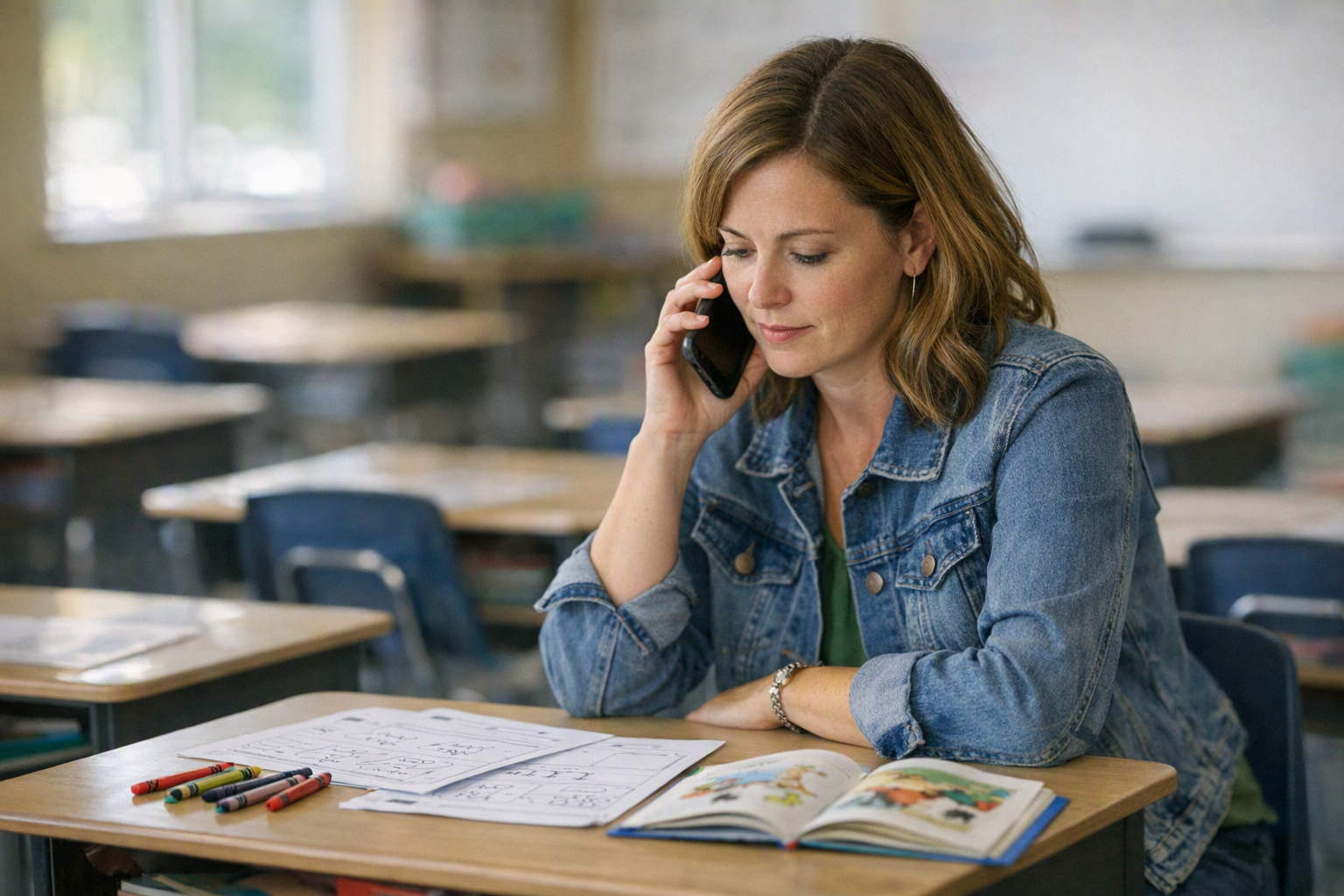
A new peer-reviewed study suggests that when first graders were pushed into emergency pandemic schooling, the most important protection may not have been the worksheet or the platform but the teacher who kept reaching out. In an Aug. 19 paper in npj Science of Learning, researchers reported that first-grade students in Baden-Württemberg, Germany, showed no overall achievement decline in this sample under pandemic schooling. But students who had higher teacher-student contact during closures posted stronger math outcomes, and children with lower contact showed steeper drops in motivation, especially in language-related interest and self-concept.
The study stands out because it looked at children right at school entry, a moment when routines, confidence, and relationships are still being built. The researchers analyzed multicohort data from 2,740 first graders, measured at the beginning and end of the school year, and argued that the timing offers unusual evidence about what disruption does to students just entering formal schooling during the pandemic’s first wave. (pubmed.ncbi.nlm.nih.gov)
That finding cuts against the simplest version of the COVID learning-loss story, not because the broader literature was wrong, but because it was incomplete. A 2021 systematic review found generally negative effects of spring 2020 school closures on achievement, with younger students and students from low-SES families hit harder. A 2025 global analysis in the same journal also estimated average post-pandemic score declines, with larger losses where closures lasted longer and among disadvantaged students. This new first-grade study adds an important complication: losses were not universal, and the quality of support appears to have mattered. (frontiersin.org)
Baden-Württemberg’s policy context helps explain why. The state announced school closures on March 16, 2020 and said remote support could continue through tools including Moodle and other analog or digital communication. By June 29, 2020, the state had moved back to regular attendance for all children in primary schools under pandemic conditions. In other words, this was not a full year of abandonment; it was a compressed period in which schools were improvising and teachers’ contact practices varied. (baden-wuerttemberg.de)
Achievement held up, but motivation did not
The headline result is easy to misread. The paper did not find that pandemic schooling was broadly beneficial. It found no overall achievement decline in this sample, then identified meaningful differences inside that average. High teacher-student contact was associated with higher math achievement than regular schooling, while motivational outcomes were worse on average in language domains, particularly for interest and self-concept. Those motivational losses were especially pronounced when teacher-student contact was low and family socioeconomic status was low. (pubmed.ncbi.nlm.nih.gov)
For educators, that pattern matters because it separates two questions that emergency plans often blur together: whether children can keep up with academic content, and whether they still feel like successful learners while doing it. The study suggests those are not the same problem. A system might keep average scores from collapsing and still allow early language motivation to erode, particularly among children who already have fewer resources at home. (pubmed.ncbi.nlm.nih.gov)
That is a sharper warning than a generic call for “more engagement.” The paper’s own framing points to teacher-student contact as the buffering factor, and one snippet from the article notes that individual contact was rare on average during closures and varied substantially across teachers. If that variation tracks real differences in practice, then contingency planning has to specify who checks on whom, how often, and through what channel, not just where assignments are posted. (nature.com)
What this study should change — and what it should not
The result is also plausible in light of a broader research base on teacher-student relationships. A recent second-order meta-analysis summarized evidence that stronger teacher-student relationships are positively related to academic achievement, motivation, well-being, and other outcomes. This new paper does not prove the same mechanism in a shutdown setting, but it fits the larger idea that younger students experience instruction partly through relationship, not only through content delivery. (pubmed.ncbi.nlm.nih.gov)
Still, school leaders should resist turning this into a simplistic prescription such as “increase contacts and scores will rise.” The authors analyzed naturally occurring cohort data rather than a randomized intervention, so the findings are best read as associations in a specific context. High-contact classrooms may also have differed in school organization, family responsiveness, local conditions, or teacher capacity in ways the study cannot fully separate. (pubmed.ncbi.nlm.nih.gov)
Generalization is another limit. The study speaks directly to first graders in one German state during the first wave of COVID disruption. That is a strength if the question is what very young children need during abrupt interruptions to schooling. It is a weakness if readers try to port the result wholesale to middle school asynchronous learning, college instruction, or ordinary non-crisis teaching. The paper’s value is most immediate for contingency planning: remote days, weather closures, outbreaks, and other short-run disruptions where schools must decide what absolutely cannot be allowed to drop. (pubmed.ncbi.nlm.nih.gov)
The practical lesson is about reachability
For U.S. educators, the most transferable lesson is not about copying Baden-Württemberg’s exact response. It is about deciding what counts as continuity for six- and seven-year-olds. If the essential promise of school continuity is merely that packets, apps, or videos are available, this study suggests that may miss the most fragile outcome: whether children still see themselves as competent learners, especially in language-heavy work. If the promise includes regular teacher contact, the odds of protecting both motivation and at least some academic performance may be better. (pubmed.ncbi.nlm.nih.gov)
That has operational consequences. A serious closure plan for early elementary grades may need a minimum live or one-to-one check-in cadence, a backup communication channel for families that do not answer digitally, and a priority list for students whose motivation is most at risk. The study does not give administrators an exact dosage. It does suggest that “instruction delivered” and “student supported” should be tracked as different things. (pubmed.ncbi.nlm.nih.gov)
The paper arrives six years after the first shutdowns, at a moment when many schools are writing continuity plans for very different disruptions: wildfire smoke days, illness clusters, staffing gaps, and attendance interruptions that do not look like 2020 but still break classroom rhythm. Its clearest message is that for beginners in school, human contact may be a core instructional input, not an optional extra. The next question worth watching is whether later studies find the same pattern in older grades, where independence is higher but disengagement can be harder to detect until it is already entrenched. (pubmed.ncbi.nlm.nih.gov)
More from K-12
Nevada halts midyear school cuts with emergency enrollment rule
Nevada will temporarily fund districts, charter schools, and the state’s university school for profoundly gifted students using higher enrollment figures already assumed in the 2025 budget, easing immediate pressure for layoffs and program cuts while leaving a longer-term funding fix unresolved.
Ohio’s 2026 school report cards show gains in reading, math, attendance
New Ohio report cards show statewide five-year highs in English language arts and math, lower chronic absenteeism, and stronger postsecondary readiness. But several of the state’s largest urban districts still posted overall ratings between two and three stars, making the subgroup and component data more useful than the headline star count alone.
Poughkeepsie adopts one K-8 curriculum to replace a patchwork
The district approved HMH across K-8 just before the new school year, pairing the switch with teacher training, parent progress access, and repeated implementation support.