Duval’s AI and cybersecurity plan starts by retraining teachers
Jacksonville University will run a four-week blended program for Duval middle and high school educators, pairing training with curriculum design, classroom visits, and optional computer science certification support.
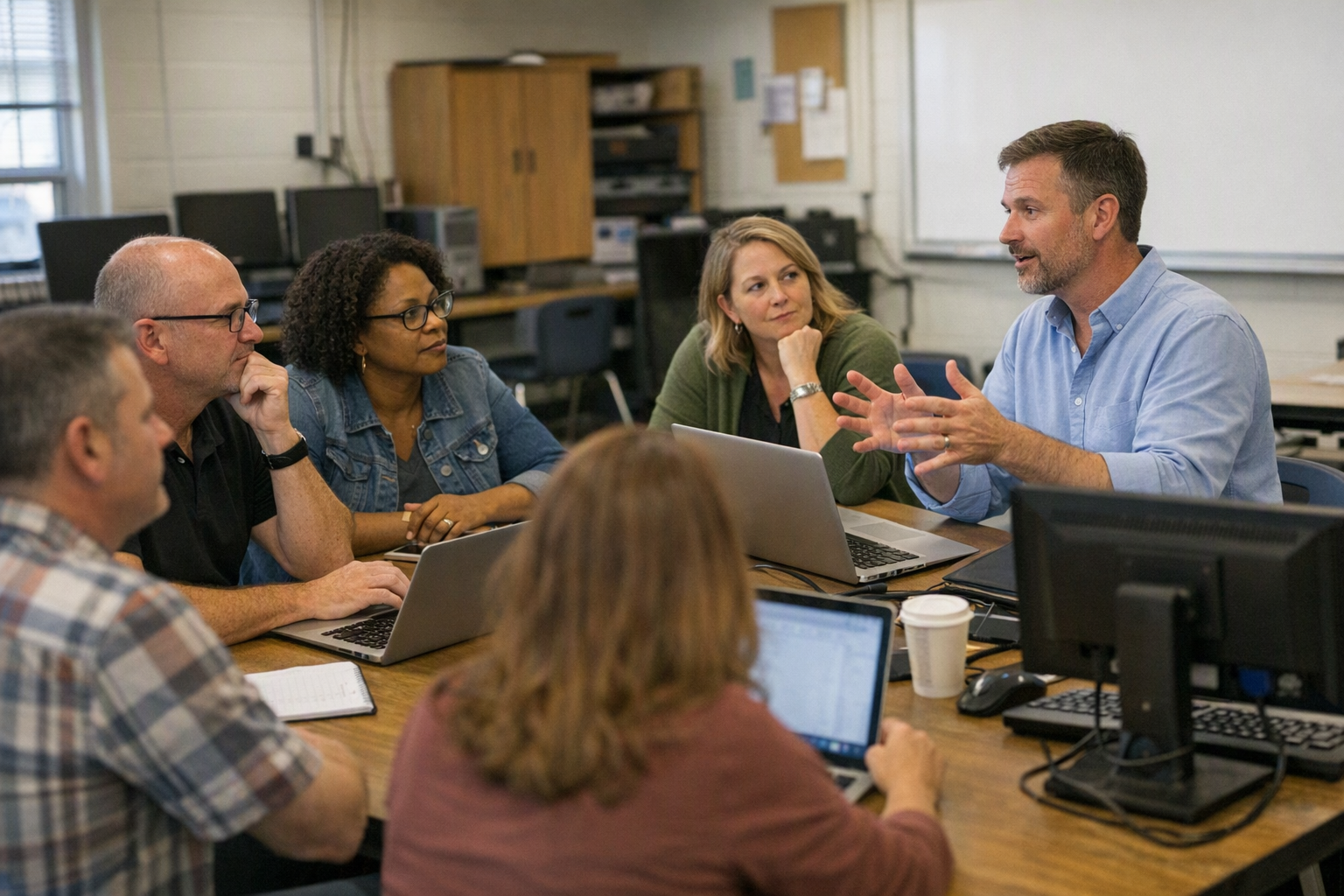
Jacksonville University is taking on a very specific part of Duval County Public Schools’ AI-and-cyber expansion: retraining teachers who are already in schools. In an Oct. 14 announcement, JU said it will design and deliver a four-week professional development program for Duval County middle and high school educators as part of CyberJaxAI-PATH, a regional coalition led by the University of North Florida. JU said the effort is backed by a three-year National Security Agency award worth more than $720,000; UNF described the same award as more than $700,000. (visit.ju.edu)
What changed this week is not the existence of AI talk in Duval classrooms, but the public release of a staffing model. JU said its role will include the four-week blended training, collaborative curriculum design and assessment, and faculty-led classroom visits and experiential learning. UNF said the broader coalition will build AI-integrated cybersecurity curriculum, create pathways into dual enrollment and university programs, and evaluate and share what it learns. What the public announcements do not yet say is how many teachers will be in the first cohort, which schools or courses will be involved first, whether teachers will receive stipends or release time, or exactly when classroom rollout begins. (visit.ju.edu)
That makes this less a story about one more grant-funded pilot and more a practical playbook for districts that want to offer serious AI or cybersecurity coursework before they have a perfect hiring pipeline. The notable part is the sequence: train current teachers, build curriculum with higher-ed faculty, support certification, and bring university staff into classrooms rather than stopping at a workshop. For school systems that already have teachers in math, science, career-tech, business, or technology roles, that is a much more plausible staffing move than waiting for enough fully formed AI specialists to appear on the market. (visit.ju.edu)
A district that already had AI momentum
Duval is not starting from zero. In March 2025, the district said it was launching its first AI Institute after initially introducing Microsoft Copilot and other AI supports to staff. By July 2026, a district AI Summit was showcasing teachers using AI for differentiated learning, guided student research, and classroom support. At the same time, DCPS already has a large career-tech footprint, reporting more than 21,000 CTE students, 68 high school career academies, and more than 400 course offerings districtwide. Its middle school CTE pages already advertise student certifications in areas including computing, multimedia, and cybersecurity. (dcps.duvalschools.org)
That context matters. Districts often move through AI in stages: first as a teacher productivity tool, then as a student-use and ethics question, and only later as a curriculum and staffing question. CyberJaxAI-PATH appears to push Duval into that third phase. Instead of asking only how teachers should use AI responsibly, the coalition is asking who is prepared to teach AI-integrated cybersecurity concepts to middle and high school students, and how those courses connect to dual enrollment and college pathways. (dcps.duvalschools.org)
Why the four-week design is the real story
JU’s public outline is unusually concrete for an early-stage partnership. The university said the professional development model will blend self-paced online coursework with intensive in-person instruction and include optional support for the Florida Teacher Certification Examination in Computer Science K-12. Florida recognizes Computer Science as a K-12 certification area, and the state lists subject-area examinations that can be used to qualify for a temporary certificate or an addition to a certificate. In other words, JU is not only promising inspiration; it is tying the training to the credential structure that can actually let schools staff courses. (visit.ju.edu)
That is a meaningful distinction because computer science staffing remains thin in many schools. A 2022 national landscape survey from the Computer Science Teachers Association and partners found that 33 percent of CS teachers were the only CS teacher at their school. The 2025 follow-up report found a teacher corps committed to students but constrained by limited preparation, heavy workloads, time restrictions, and inconsistent support. Duval’s new pathway does not solve those national problems, but it does address one of the most immediate local ones: how to get enough adults ready to teach something new without waiting years for preservice pipelines to catch up. (landscape.csteachers.org)
The model also tries to fix a common professional-development failure point. Too much tech PD leaves teachers with broad encouragement and very little they can schedule next semester. CyberJaxAI-PATH’s public design pairs content training with collaborative curriculum work, assessment planning, and faculty classroom visits. That combination suggests the coalition understands that course rollout breaks down less often on vision than on implementation: lesson materials, pacing, equipment, teacher confidence, and what happens when the first unit reaches real students with mixed background knowledge. That is an inference from the project design, but it is a reasonable one. (visit.ju.edu)
There are still real trade-offs. Four weeks is fast by district standards, but AI and cybersecurity are both deep fields, and middle school exposure is different from high school course delivery. A compressed model can widen access to training, yet it also places a premium on careful teacher selection, follow-up coaching, and principal support once school schedules, testing windows, and staffing gaps intrude. The public materials do not yet say how much ongoing coaching teachers will receive after the initial training or how DCPS will protect time for curriculum buildout. Those details may decide whether the pathway becomes a durable staffing strategy or a promising pilot that strains against the rest of the school day. (visit.ju.edu)
What other districts can borrow from this
The most transferable lesson is not the federal grant itself. It is the division of labor. UNF is leading the coalition and framing the pathway into curriculum, dual enrollment, and evaluation. JU is handling teacher retraining, curriculum support, and classroom engagement through its cybersecurity infrastructure. DCPS supplies the schools, the teacher pipeline, and an existing CTE system large enough to absorb new offerings. Florida law already contemplates district or consortium funding to help classroom teachers earn computer science certification, which makes this kind of retraining model fit the state’s broader policy architecture even when the dollars come from elsewhere. (unf.edu)
That makes the Duval model attractive to other districts that have a community college, a regional university, and a handful of teachers who are teachable into the field even if they were not hired as computer science specialists. The design also keeps one eye on student pathways. UNF said the coalition will connect K-12 work to dual enrollment and university programs, which is important because many AI and cyber initiatives stall after the first course. Students need a next step, and schools need a reason to believe the new class is not a dead-end elective. (unf.edu)
What to watch next is straightforward: the first cohort size, the first schools, the first courses, and the amount of teacher time protected for actual buildout. If CyberJaxAI-PATH can show that a short, blended retraining model produces classroom-ready units and teachers who stay in the work, it will offer districts a more realistic answer to the AI staffing problem than most big-picture strategy documents do. If it cannot, the lesson will be just as useful: even the best regional coalition cannot shortcut the need for time, coaching, and sustained teacher support once the pilot meets the master schedule. (visit.ju.edu)
More from Teaching & Learning

England widens two faster routes to QTS ahead of academy deadline
Updated DfE guidance eases the assessment-only route for some experienced teachers and lets teachers from eligible overseas systems apply for QTS regardless of subject. But separate September rules still exclude applicants trained in Ghana, India and Nigeria.

EEF trial finds Oak’s Aila cut KS2 planning time by 24%
Lesson resources were rated no worse than the comparison group’s in the 10-week EEF and NFER trial of 464 Key Stage 2 teachers across 108 schools, though average use of the tool fell over time.

Howard County backs 22 teacher pilots with more than $30,000 in microgrants
The Bright Minds awards fund educator-led tests in AI literacy, peer mental health support, literacy access, adaptive life skills, environmental learning, and school culture across more than 20 schools.