A Wisconsin grant shows 4 ways schools are building AI and STEAM
The Sentry Insurance Foundation is funding one districtwide AI initiative and three school-based STEM or STEAM hubs through 2028. Together, the projects offer a practical look at how schools are pairing equipment with curriculum, staffing, and student outcomes.
Four Wisconsin school systems just got one $1.5 million test case for what local AI and STEAM expansion can actually look like
The Sentry Insurance Foundation has awarded $1.5 million to four Stevens Point-area school systems for AI, STEM, and STEAM projects running through 2028, creating an unusually clear side-by-side look at how schools are trying to turn broad technology promises into actual labs, courses, and student work. The foundation’s official announcement is dated July 16, and local radio coverage followed on July 20. Sentry’s announcement says the money will support one public-district AI initiative and three private-school STEM or STEAM hubs. WSAU’s July 20 report adds local reaction from school leaders.
What makes the award notable is not the dollar figure alone, but the design split. The Stevens Point Area Public School District, which says it serves more than 7,000 students, is using its share for The AI Forge, a district project aimed at helping staff, students, and families use AI ethically and effectively, anchored by a high school AI Innovation Lab with tools for AI, cybersecurity, data analytics, and digital design. Pacelli Catholic Schools, Stevens Point Christian Academy, and St. Paul Lutheran School are each pursuing a more school-based model: a makerspace-style STEAM center, a literacy-linked robotics and product-design expansion, and a STEM career-pathways project. What remains uncertain, at least from the public materials released so far, is how much each school received, which staff will run the work day to day, and how success will be measured before the grants end in 2028. (sentry.com)
Four projects, four different theories of action
The district plan is the most explicit AI build. In Sentry’s description, The AI Forge is not pitched as a single classroom makeover. It is framed as a system meant to support staff, students, and families, with a lab at the high school level and an emphasis on ethical use, AI literacy, computational thinking, and career preparation. That matters. A lot of school AI talk still stalls out at policy memos or one-off pilot tools. Stevens Point’s version, at least on paper, connects governance, community communication, and workforce-facing coursework in one package.
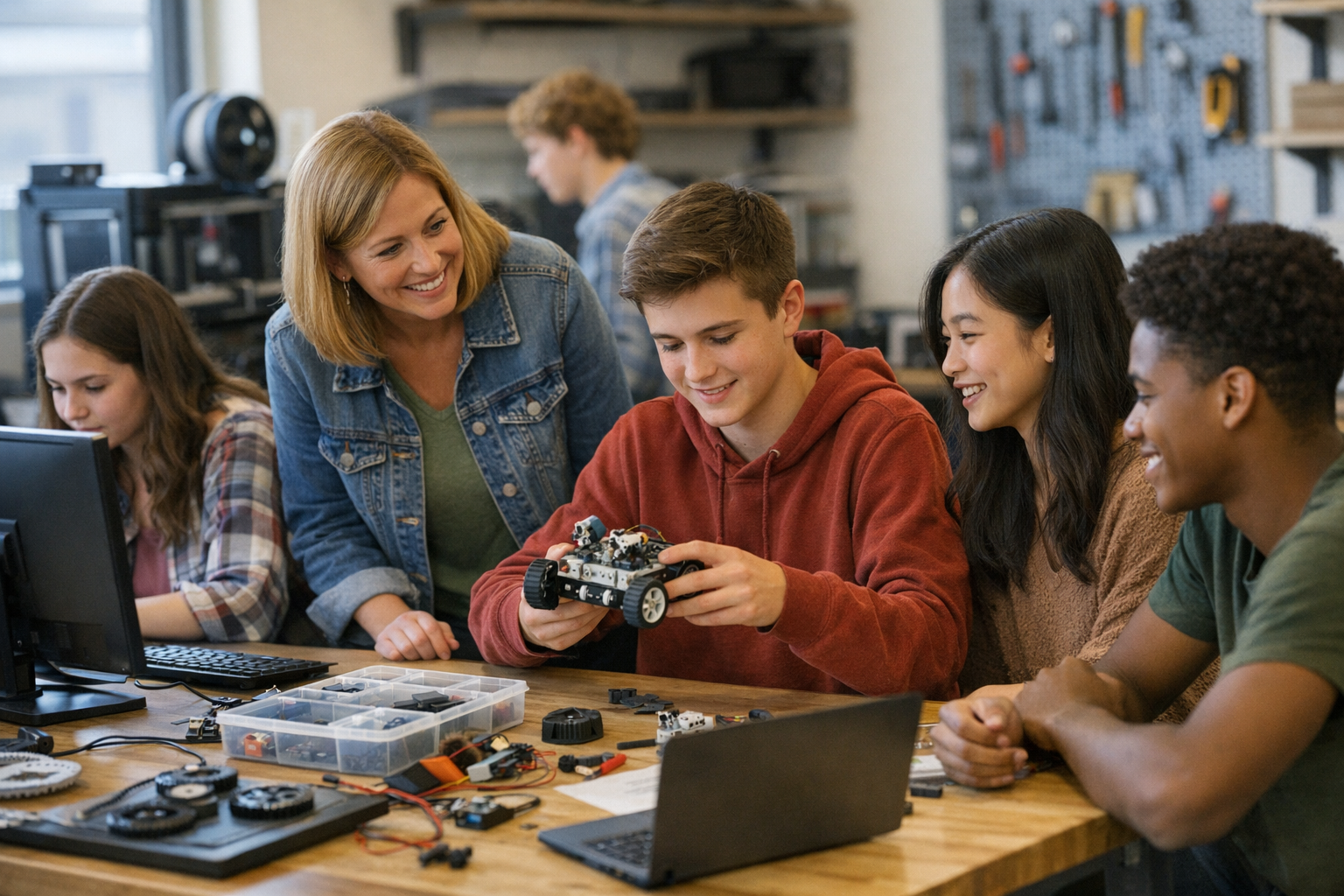
Pacelli’s model is more concrete and more old-school in the best sense: build a place, equip it, and make students produce something. The official announcement says Pacelli Catholic High School will create a SMART Lab STEAM Center with computers, 3D printers, and robotics kits, ending in a capstone course where students design, create, market, and sell products. Because Pacelli’s system serves preschool through grade 12 but the grant is centered in the high school, the project looks less like a general tech refresh and more like a pathway bet: hardware plus project-based learning plus entrepreneurship. That is a different theory of action from the district’s AI-governance model.
Stevens Point Christian Academy’s Phase II project is different again. Sentry’s release says it will connect reading achievement, AI-powered robotics, product design and manufacturing, and science instruction through data collection and analysis. For school leaders elsewhere, that may be the most transferable idea in the batch. The academy presents itself as a K-12 school with “21st Century Technology in All Classrooms,” so the new spending appears to be an add-on to an existing identity rather than a sudden pivot. The interesting move is the literacy link: if robotics lives only as an elective or club, it stays peripheral; if it is tied to reading, writing, and analysis, it has a better chance of reaching more students and surviving the novelty phase.
St. Paul Lutheran School’s project is the least flashy in name and may be the most practical. Sentry says the school’s STEM Career Pathways Innovation Project will expand science, math, and engineering through advanced technology, project-based learning, and career exploration. St. Paul’s own site shows a school spanning early childhood and elementary/middle grades rather than a high school campus, which changes what “career pathways” can realistically mean. In this setting, the work is less about immediate credentialing than about building habits of making, measuring, and problem-solving early enough that students arrive at high school ready to choose stronger pathways later.
The real implementation question is not equipment. It is staffing and coherence.
These four plans also expose a common problem in school innovation: buying tools is easier than designing instruction that outlasts the ribbon cutting. The public district’s version will likely face the heaviest coordination burden. Stevens Point says it has more than 1,000 staff members, already runs district technology services, and uses a digital citizenship curriculum built from Common Sense Media resources. The district also tells families it uses a software approval and privacy review process aligned to FERPA, COPPA, and CIPA. In that context, The AI Forge is as much a change-management project as a room full of devices. If the district can fold AI use into existing privacy, curriculum, and family-communication systems, the lab could become a real instructional backbone. If not, it risks becoming a specialized space that only a slice of students ever sees. (pointschools.net)
The private-school models may have an easier time building coherence because each school is smaller and mission-driven, but they carry a different risk: dependence on a few staff members. Pacelli’s capstone model only works if teachers can bridge engineering, design, and business. Stevens Point Christian Academy’s literacy-robotics model only works if classroom teachers can connect reading and technical tasks rather than treating them as separate blocks. St. Paul’s career-pathways model only works if project-based learning is sustained across grades instead of parked in one enthusiastic classroom. None of those are impossible. But they are personnel questions, not purchasing questions, and the public release does not yet spell out staffing, teacher training hours, or long-term operating costs. (sentry.com)
That is especially important because the four schools are not interchangeable test sites. The public district is simultaneously engaged in a long-range facilities planning process shaped by projected enrollment decline and excess space concerns, while the three private schools are smaller systems with different governance, admissions, and budget pressures. A districtwide AI effort in a large public system answers one problem: how to set norms and access at scale. A private-school makerspace or robotics expansion answers another: how to build a distinctive program quickly enough to shape student experience and school identity. Readers should resist treating any one of the four as the single “right” model. They are solving different operational problems.
What to watch before this becomes another glossy grant story
The public documents make clear that this is not Sentry’s first round with these partners. In its 2023 announcement, the foundation awarded $1.7 million to the same four school systems for earlier STEM and STEAM projects, including elementary and middle-school SMART Labs at Pacelli, K-12 STEAM work at Stevens Point Christian Academy, and gamified STEM classrooms at St. Paul. That history cuts both ways. On one hand, it suggests these schools are building on existing infrastructure rather than starting from zero. On the other, it raises the question that matters most for 2026-27: what has the earlier money already changed, and how will this new round deepen instruction rather than simply add another branded space?
Before school starts, the useful things to watch are mundane: course catalog changes, staffing assignments, professional-development plans, software vetting, family guidance on AI use, and whether students outside the obvious tech track can actually reach these programs. The strongest idea in this grant round is that each school tied tools to an output: ethical AI use, capstone products, literacy and robotics integration, or early career exploration. By 2028, the real measure will be whether those outputs show up in schedules, student work, and postsecondary pathways after the grant cycle fades from the news. (sentry.com)
More from EdTech & AI

Google expands AI teacher training in UK and Ireland, alongside governance tools
Google’s free, short Gemini-focused modules are now being rolled out more widely to educators in the UK and Ireland. The companion governance materials, developed with England’s National Governance Association, are better read as a practical policy starting point than a ready-made framework for every school in the region.

Promethean adds on-device AI lesson builder to Explain Everything
The new AI Companion can turn existing slide content into lesson plans, quizzes, vocabulary lists, translations, audio narration, and accessibility descriptions on compatible iPads and iPhones, with Promethean saying the processing stays on the device.

Canvas Lite launches as a free LMS for tutors and homeschool educators
Instructure’s new no-cost Canvas tier brings modules, quizzes, rubrics, and SpeedGrader to solo educators, but it also replaces Free-for-Teacher with ID verification, smaller class limits, and a short migration window for former users.