Stanford pulls AI-edited student banner after policy violation
The university said an altered promotional image changed a student’s race and gender, was used without disclosure, and should never have been approved. Stanford has apologized, removed the banner, and says staff training and review will be tightened.
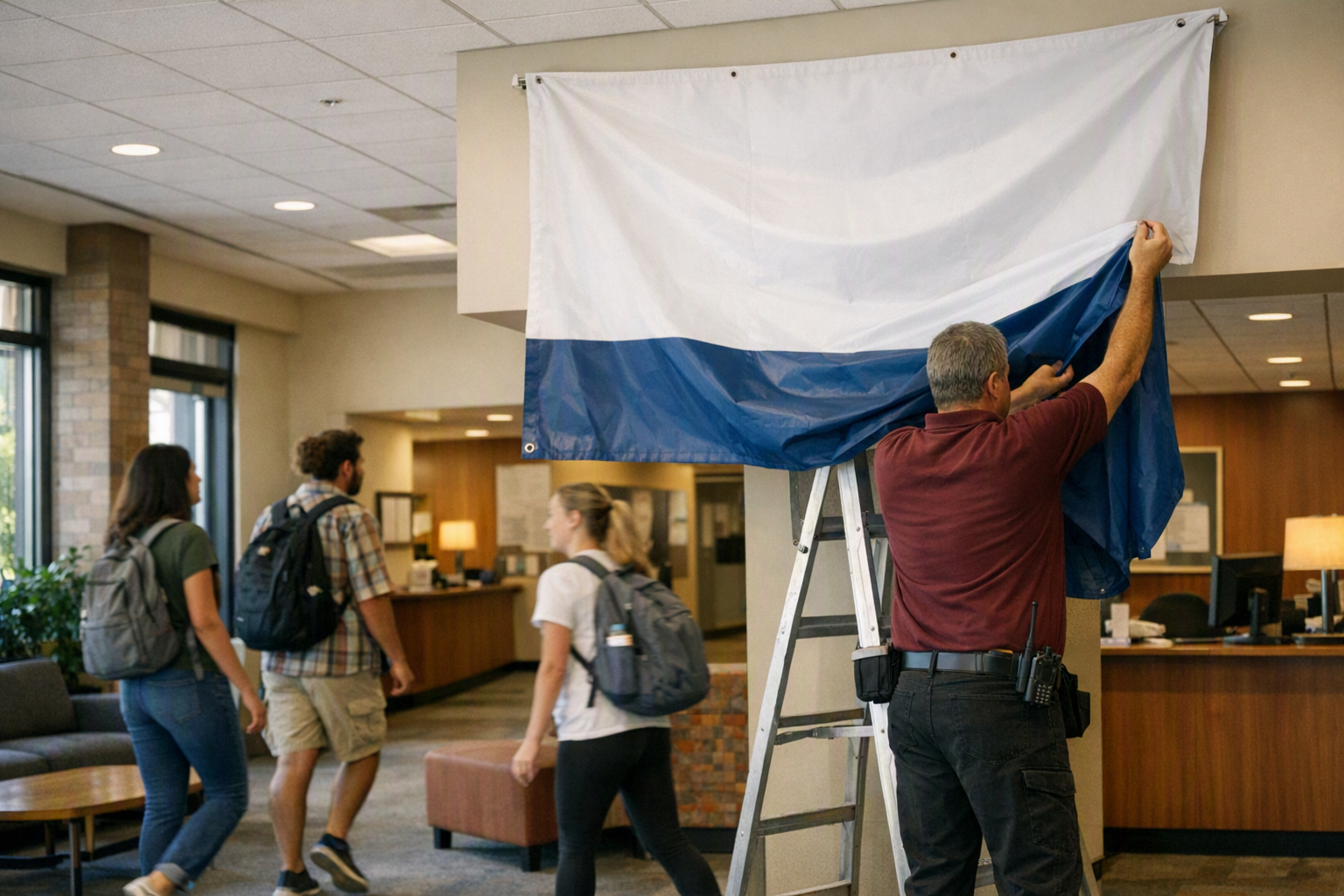
Stanford University said this week that a campus promotional image altered with generative AI violated university policy after the edited banner changed a student’s race and gender, slimmed two students’ faces, and swapped clothing for Stanford-branded apparel. The university has removed the banner, apologized to the students involved, and said it will add staff training and stronger review of communications materials. (stanforddaily.com)
What changed is not just the image itself, but Stanford’s public posture. The image was used by Residential & Dining Enterprises, the university unit that oversees student housing and dining, and campus reporting confirmed that it appeared on a custom banner in the Governor’s Corner housing center before being taken down. Stanford has also said it opened an investigation into how the image was made and approved. That leaves several questions unresolved, including who signed off on the final banner, how long it was displayed, and whether any other altered materials are under review. (rde.stanford.edu)
According to The Stanford Daily, a university spokesperson said R&DE used generative AI to modify the appearance of several students in the photo. The paper reported that the edit changed one student’s race, gender, and overall appearance; turned students’ clothing into Stanford merchandise; and slimmed two students’ faces. In its Sept. 24 follow-up, NBC News reported that Stanford called the alterations “a serious error in judgment” and said, “this was wrong and should never have happened.”
Policy on paper, failure in workflow
The clearest fact in the case is that Stanford is not claiming this was a gray area. Charlene Gage, the university’s public relations director, told The Daily that “the use of AI in producing or altering images of Stanford people, events, research, facilities, or achievements is strictly prohibited,” and that both the alteration and the lack of disclosure violated policy. Stanford’s current University Communications guidance similarly says staff should clearly identify AI-generated or AI-manipulated content when leaving it undisclosed could mislead audiences, and says they should not create or publish AI content that falsely depicts Stanford people, events, research, facilities, or achievements. (stanforddaily.com)
That matters because Stanford has spent the last two years building a public framework for “responsible” AI use, not just in classrooms and labs but across administration. A university advisory report released in January 2025 said Stanford should use AI to augment human capabilities rather than replace them, and stressed that people remain responsible for AI-assisted outputs. Stanford’s communications guidance also applies broadly across schools, institutes, and administrative units rather than only to a central media office. In other words, the rule existed, the scope was broad, and the failure appears to have been operational: a human workflow let a prohibited image reach production anyway. (provost.stanford.edu)
For college communicators, that is the more useful lesson. Many institutions have AI principles posted somewhere on an internal site. Far fewer have reliable checks between a designer’s desktop, a manager’s approval, a vendor’s print file, and the moment a banner goes up in a residence hall. Stanford’s promised remedy — more staff training and better review — suggests the university sees the problem less as an abstract policy gap than as a compliance gap in day-to-day production. (stanforddaily.com)
The issue is not only diversity optics
The story has drawn national attention because the most obvious alteration was demographic: a Hispanic male student was replaced by an AI-generated Black woman. But the governance problem is broader than the politics of representation. The same edit reportedly changed body shape and clothing, which means the image was not merely “enhanced” in the familiar marketing sense; it was turned into a synthetic depiction of real students. That is a different category of risk, especially when the people in the original frame are students whose likenesses can carry implications about identity, belonging, and institutional endorsement. (stanforddaily.com)
Stanford’s own communications rules elsewhere show why authenticity matters. In guidance for journalists using Stanford News Service photography, the university says photos may not be altered or embellished in ways that change their editorial content, and it also says people generally cannot be filmed on campus without permission outside public events. Those rules are not identical to internal marketing guidance, but together they show that Stanford already treats visual accuracy and personal permission as core communications concerns. Generative AI did not create those concerns; it compressed them into one fast, easy workflow. (ucomm.stanford.edu)
A warning for decentralized campuses
The Stanford case also lands as colleges are expanding AI use faster than they are standardizing safeguards. A Student Defense report released Sept. 17 argued that institutions are embedding AI across recruitment, admissions, financial aid, counseling, tutoring, and teaching while student protections lag behind. Stanford’s banner controversy is far less consequential than an AI system making admissions or advising decisions, but it is easier for most campus teams to recognize. It is a small, visible example of the same institutional challenge: once AI tools spread into ordinary workflows, governance has to reach the unit level.
That is especially true at large universities, where student-facing communications are produced by housing offices, dining services, admissions teams, schools, centers, labs, and contractors — not only by the central communications shop. Stanford’s own guidance says its marketing and communications AI rules apply to staff, interns, consultants, and contractors working on behalf of the university across administrative units and affiliated programs. The practical implication is straightforward: if institutions want authentic student storytelling, they need more than a policy PDF. They need consent practices that cover reused images, clear rules on when AI edits are forbidden versus merely disclosable, version control that preserves originals, and a review process capable of catching synthetic identity changes before they are printed at campus scale. (ucomm.stanford.edu)
Stanford has already acknowledged the banner should not have existed. The next development worth watching is whether the university treats that admission as the end of the matter or as the start of a more concrete governance reset: an audit of existing materials, clearer approval lines, and public-facing rules specific enough that student-affairs and marketing teams across campus can actually follow them. Until then, the episode stands as a sharp reminder that an AI policy is only as real as the last image review before publication. (stanforddaily.com)
More from Higher Education
ABA law-school accreditor deadlock sends case to Education Department
A federal advisory panel failed to recommend whether the ABA should keep recognition, leaving a senior department official to decide next steps as freestanding law schools watch the closest Title IV risk.

Boston launches a train-then-teach public health pipeline with UMass Boston
Under the new yearlong model, UMass Boston seniors train with public health professionals this fall and move into supervised high school health teaching in spring 2027, offering other cities a practical template for turning internships into school-day instruction.

Review finds broad failures in Connecticut college system harassment response
An independent review said board leaders and administrators failed to follow required reporting and response procedures in harassment complaints involving former interim chancellor O. John Maduko. The findings land as CSCU is in leadership transition and preparing a national search, putting board governance, Title IX oversight, and executive complaint processes under immediate scrutiny.