NASA opens teacher pre-registration for next TechRise challenge
Teachers can sign up now to plan for the 2026-27 TechRise challenge, which is expected to open in September and send 60 winning school experiments on a high-altitude balloon.
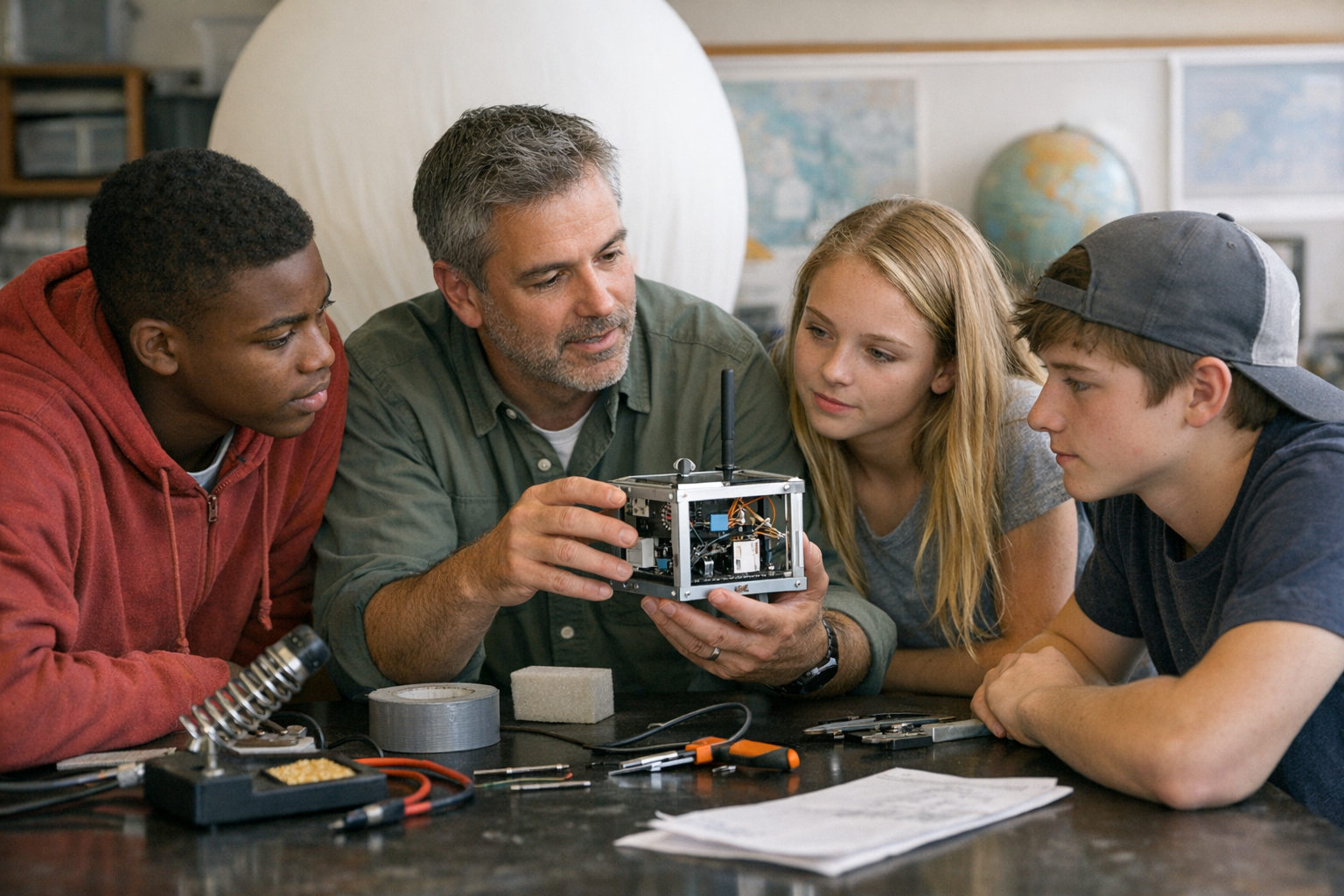
NASA and Future Engineers have opened teacher pre-registration for the 2026-27 NASA TechRise Student Challenge, giving schools an early planning window for a nationally recognized STEM competition that is expected to open fully in September 2026. NASA’s updated TechRise overview now points educators to pre-register for next year’s round, while Future Engineers says the next cycle will fly on a high-altitude balloon.
For teachers, after-school robotics leads, and school leaders deciding now what will anchor a fall engineering project, the practical question is less whether TechRise sounds exciting than whether a school can staff it like a real build season. The official program model is bigger than a one-off contest: NASA says teams of students in grades 6-12 at U.S. public, private, or charter schools, including schools in U.S. territories, work under an educator’s guidance to design an experiment for a NASA-sponsored suborbital flight test, and winners receive $1,500 plus support to build their payloads. As of Tuesday, July 21, 2026, however, the 2026-27 pages do not yet post a full application deadline or a complete new rules packet. (nasa.gov)
That timing matters because NASA has just come through the most visible part of the current challenge cycle. In a July 1, 2026 flight summary, NASA said students from 25 middle and high schools watched their experiments launch aboard a World View high-altitude balloon from Page, Arizona, and NASA’s main TechRise page says the remaining 35 winning experiments from the 2025-26 round are still slated to fly on a Virgin Galactic Suborbital-Spaceship. NASA also says the 2025-26 challenge drew its highest number of entries and widest geographic participation in a single year so far, with more than 370 students from 52 states and territories.
What teachers can do before September
The official next step is straightforward: educators can pre-register through Future Engineers now. The registration flow is set up around a teacher account and class management dashboard; the page says each class receives a unique code so students can be attached to that teacher’s roster, and it also offers Google login for educators who want to sync with Google Classroom. That does not open the challenge itself yet, but it does let schools get organized before the formal application window begins.
What schools still cannot do is plan to a confirmed deadline. Future Engineers says only that the challenge is expected to open in September 2026. The best official benchmark available today is last year’s NASA listing for the fifth TechRise challenge, which opened on September 4, 2025, and closed on November 3, 2025. That prior calendar suggests schools may again get a fall application window, but educators should treat that as a planning reference, not a promise. Neither the current NASA overview nor the current Future Engineers pre-registration page lists an entry fee for the 2026-27 cycle. (futureengineers.org)
NASA’s “no experience is necessary” language will be reassuring to schools that have not run aerospace projects before, but it should not be mistaken for a low-lift program. Future Engineers says winning teams spend their spring semester building experiments and preparing them for flight, and NASA has described TechRise as giving students experience with the full process, from designing an experiment and building the payload to testing it and analyzing data after flight. In practice, that makes TechRise closer to a semester-long engineering workflow than to an essay contest with a space theme. (nasa.gov)
A balloon-only cycle changes the project math
The biggest design clue for 2026-27 is the flight platform. Future Engineers says the next cycle’s vehicle will be a high-altitude balloon, not the mix of balloon and suborbital spacecraft used in 2025-26. That matters because it narrows the kinds of student questions that make sense. In last year’s official challenge description, NASA said TechRise teams could choose between a Suborbital-Spaceship offering about three minutes of microgravity and a high-altitude balloon offering roughly four to eight hours of flight time at 70,000 to 95,000 feet. (futureengineers.org)
For classroom planning, the balloon-only format is a useful constraint. It points teams toward experiments that benefit from long-duration exposure to the upper atmosphere, temperature swings, radiation, or Earth observation rather than brief microgravity. NASA says TechRise balloon payloads experience stratospheric conditions that ground-based testing cannot fully replicate, including exposure to Earth’s upper atmosphere and high-altitude radiation. That makes the challenge a natural fit for physics, Earth science, environmental sensing, electronics, and engineering courses that can turn those conditions into a real test question. It may be less attractive for programs that want a quick fall activity without a spring build-and-test commitment. (nasa.gov)
Worth the effort if you can use it as a real build season
TechRise stands out because it is not just a branding exercise. The official pages describe real material support: 60 winning teams are expected to receive $1,500, technical support or virtual mentorship, and a NASA-sponsored flight opportunity. NASA also says teams receive a flight box or starter hardware in current and past rounds, which lowers the barrier for schools that do not already have a deep aerospace inventory. But the flip side is that only 60 teams nationwide get that funded path, so the smartest schools will treat the proposal-writing and design work as worthwhile even if they do not win. (futureengineers.org)
That is the real judgment call for educators this summer. If a school wants an authentic, externally validated project that can organize a year of design, testing, documentation, and student teamwork, TechRise looks unusually strong among national STEM opportunities. If a school needs guaranteed hands-on participation for every student, or lacks the adult time to supervise a project from fall concept work into spring fabrication, the NASA name will not change the operational reality. The next development worth watching is the full September 2026 launch of the challenge: that is when educators should expect the official deadline, updated submission requirements, and the details that will show whether this year’s pre-registration is the start of a manageable school project or an overreach for thinly staffed programs. (futureengineers.org)
More from Opportunities

Arizona teachers have until 10 p.m. Sept. 30 for $2,500 classroom grants
Fiesta Sports Foundation’s Wishes for Teachers round will give 500 Arizona public and charter school educators $2,500 each, with winners drawn at random after a brief online application.

2027 Tools Competition opens with $4.5 million for edtech ideas
Teams have until Oct. 13 to submit a short first-round abstract in one of four tracks. Three tracks are open worldwide, while the postsecondary track is limited to U.S. entrants serving U.S. learners.

Michigan Reconnect reopens for 21- to 24-year-olds
The live application creates a timely fall enrollment window for eligible Michigan residents seeking community-college or Tribal college credentials.