MIT stops exploring AI for campus security cameras
MIT says its roughly 4,600-camera network will continue without AI, facial recognition, or audio recording, giving higher-ed leaders a concrete example of written surveillance guardrails.
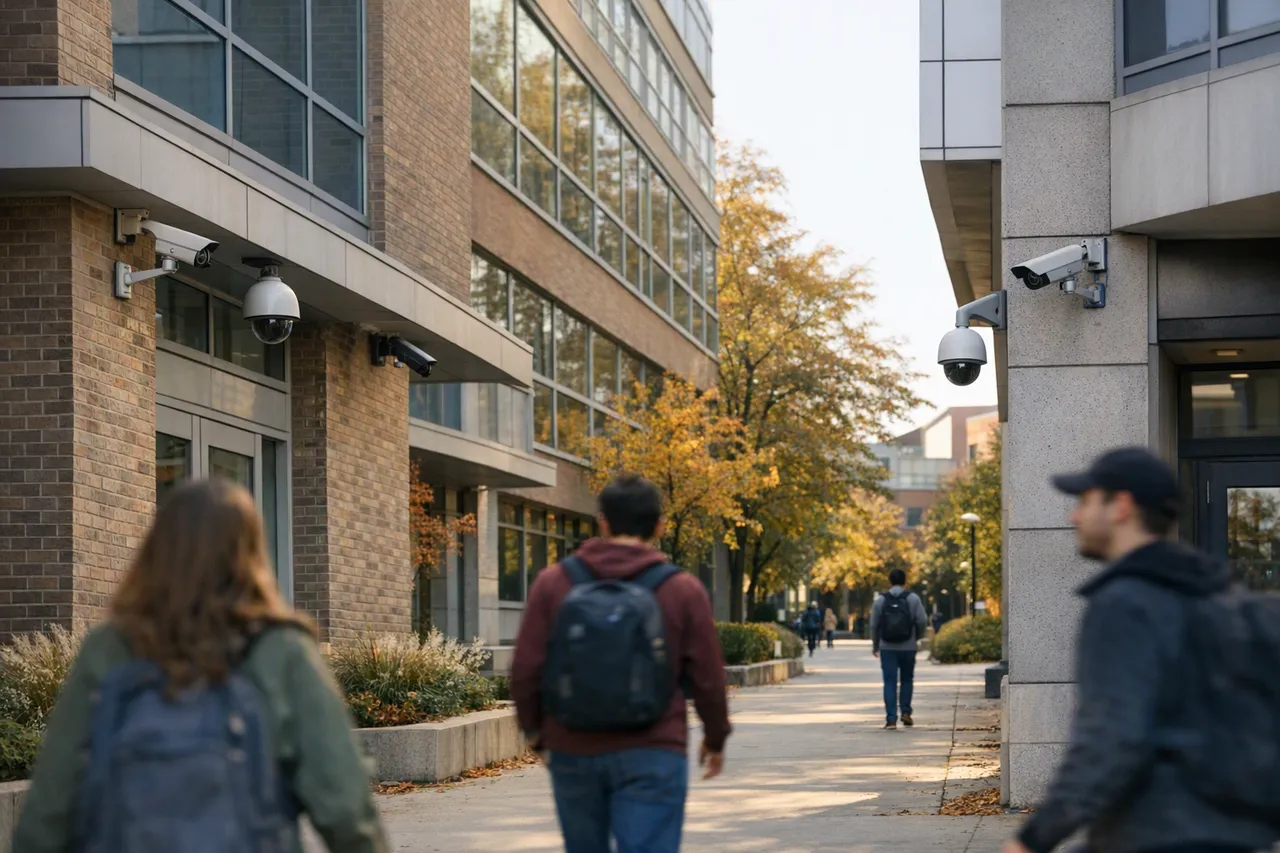
MIT has stopped exploring artificial intelligence for its campus security cameras after months of objections from faculty and other community members, and the institute now says its existing camera network will keep operating without AI, audio recording, or facial recognition. MIT’s camera FAQ, which says it reflects updates shared at faculty meetings on May 13 and Oct. 21, 2026, now states that the institute has “decided to stop the exploration” of AI for the system and has “no plans to revisit the issue.” In a separate Oct. 27 campus update, Executive Vice President and Treasurer Glen Shor said MIT had heard “significant questions” about even limited AI use and would not proceed. (evpt.mit.edu)
For higher-ed leaders asking what a credible surveillance guardrail looks like, MIT’s answer is unusually specific. The institute has put several bright lines in writing: no AI analysis of campus activity, no facial recognition, no audio recording, no routine proactive live monitoring, footage stored in an on-site data center, a default 30-day retention period, and written approval required for exceptions. That is more useful than a generic privacy promise because it tells campus constituents what the administration says it will not do, how long data lasts, and who can bend the rules. (evpt.mit.edu)
What changed, and what did not
The reversal applies to AI, not to MIT’s larger camera buildout. MIT says recent camera additions were a response to theft, vandalism, and property damage that exposed gaps in coverage. Student newspaper The Tech reported in April that MIT was spending more than $3 million on 500-plus additional cameras, with installation beginning in November 2025 and continuing into 2026. The Tech also reported that the new devices were technically capable of real-time face and object classification if those features were enabled. MIT’s current position is that whatever the hardware can do, the institute will not use AI to observe or analyze campus activity. (evpt.mit.edu)
That distinction matters for colleges weighing similar systems. MIT is not taking cameras down. The FAQ says there are about 4,600 security cameras across campus, placed on building exteriors, in entrances, lobbies, public hallways, and near high-risk infrastructure; departments, labs, centers, and institutes can also request cameras in offices or labs for local safety concerns. In other words, the institute has chosen to preserve a large conventional camera system while publicly ruling out an AI layer on top of it. (evpt.mit.edu)
MIT’s published documents also show that the pushback was not only symbolic. The FAQ says the administration created an advisory group of faculty, staff, students, and postdocs over the summer to weigh whether any AI capabilities should be used with the cameras, and that feedback from that group and other community members helped lead to the decision to stop. Outside that formal process, some professors also staged a public protest by decorating cameras with rhinestones and googly eyes without blocking them, according to local reporting from Cambridge Day. (evpt.mit.edu)
The guardrails MIT published — and the gaps it did not close
MIT’s strongest public safeguard is that it defines prohibited use in operational terms, not just values language. Shor’s Oct. 27 update says “no AI” means MIT will not use AI to monitor or analyze campus activity and will not keep exploring even limited AI capabilities. The same update says MIT does not record where community members have a reasonable expectation of privacy. The IS&T security-camera protocol adds a 30-day retention rule, identifies MIT Police as the primary investigative user of footage, and says other MIT units can gain access only in limited circumstances with written approval from a senior officer. (evpt.mit.edu)
But the public record also shows why the controversy is unlikely to end with one reversal. MIT Police can still review footage in real time after a reported incident, and the FAQ allows proactive live monitoring for a few cases such as Commencement or the Nuclear Reactor Laboratory. MIT Police may also share footage with state and local law enforcement investigating crimes captured by MIT cameras. And the governance structure MIT points to is administrative rather than a standing community veto: the Campus Safety Working Group reviews requests for new cameras, access to live or archived video, and exceptions to policy, while the Information Technology Policy Committee serves as the final governance committee for camera processes. The public documents reviewed do not describe a permanent requirement for faculty or student approval before future surveillance expansions. (evpt.mit.edu)
What other campuses can take from this case
MIT’s retreat offers a practical lesson for colleges and universities now being pitched “smart” security upgrades. A credible floor is not simply saying facial recognition is off today. It is publishing a rule set that covers prohibited capabilities, retention, storage, access, exception handling, and who signs off on changes. MIT now has much of that on paper. Its harder unresolved question is procedural: whether campus governance should happen before institutions buy and install AI-capable infrastructure, rather than after a backlash forces leaders to narrow how those systems will be used. That is the next pressure point for higher-ed operators to watch, at MIT and well beyond it. (evpt.mit.edu)
More from Higher Education

Education Department finalizes accreditation rule, with 2027 compliance date
The final federal overhaul takes effect July 1, 2027, and gives colleges a clearer prep list now: revisit transfer-credit policies, tighten student-outcomes evidence, and organize academic-freedom, legal-compliance, and governance records while accreditors develop their own guidance.

Student-loan uncertainty can keep hurting borrowers after forms are filed
A qualitative working paper based on interviews with 72 borrowers suggests repayment trouble is also a records-and-trust problem, giving colleges a case for ongoing, alumni-facing support instead of one-time counseling.
Arizona Regents’ Cup applications open with Nov. 13 deadline
Full-time students at ASU, NAU, and the University of Arizona can apply by Nov. 13 for the 2027 Regents’ Cup. The competition offers scholarships, coaching, and possible credit, but selected students should expect spring preparation that can vary by campus.