Indiana absenteeism improves again, with lessons from two local turnarounds
State data show chronic absenteeism fell to 14.9% in 2025-26, though rates remain highest in high school and above pre-pandemic levels. Two Indiana case studies point to a practical playbook: spot risk earlier, contact families quickly, and follow up before absences harden into a pattern.
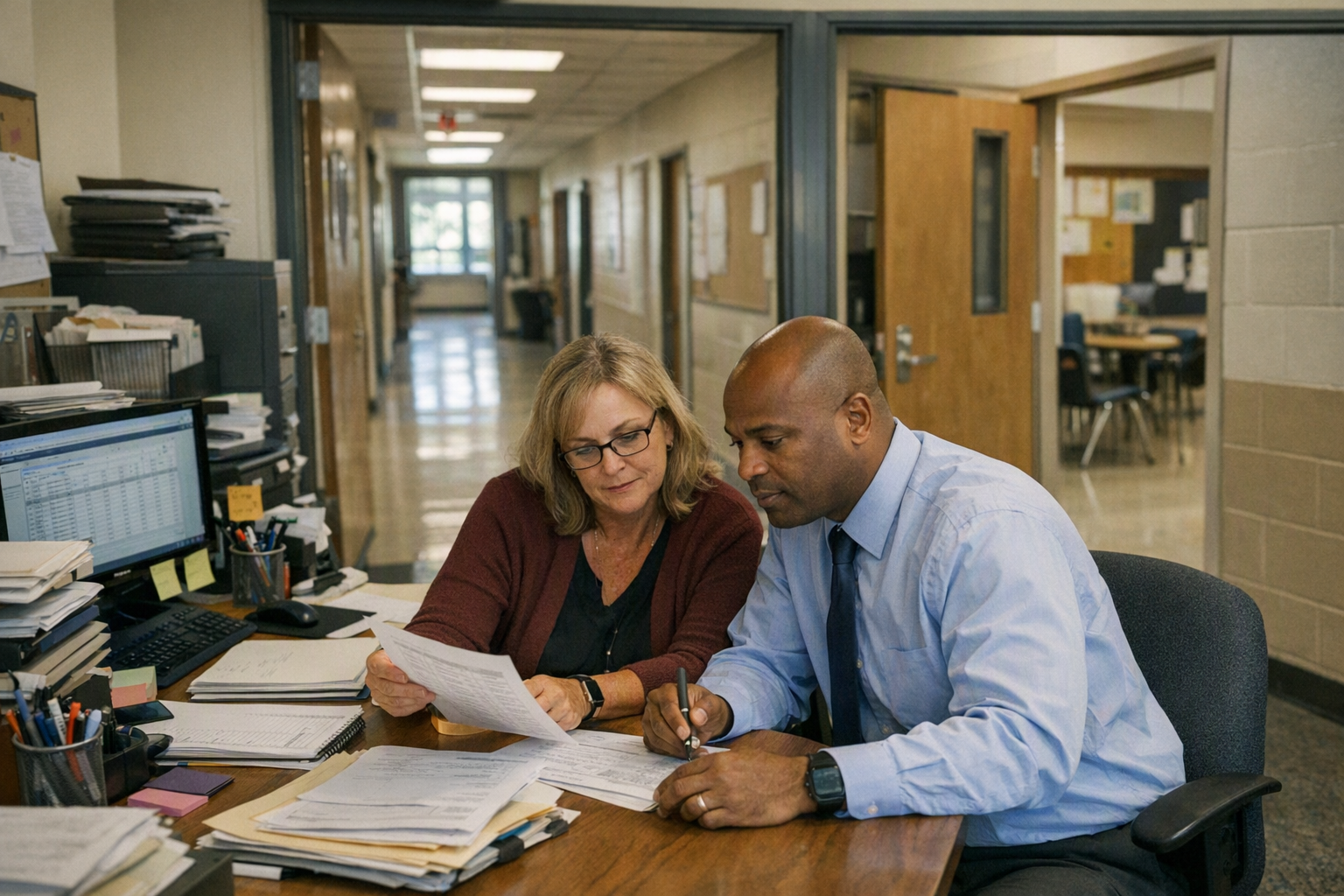
Indiana’s statewide chronic absenteeism rate fell to 14.9 percent in the 2025-26 school year, marking a fourth straight year of improvement, according to data presented to the State Board of Education on October 21. The new state materials also singled out two local turnarounds — Springs Valley Community School Corporation and Lawrence County Independent Schools — that officials said point to a practical playbook: catch attendance problems earlier, communicate with families faster, and intervene before a pattern hardens. (in.gov)
That is real progress, but not a return to normal. Indiana’s absenteeism rate has improved by 6.3 percentage points since its 2022 peak, yet it still sits well above the pre-pandemic rate of 10.6 percent. And the students still missing the most school are older teenagers: board-meeting coverage reported that about 30 percent of seniors were chronically absent in 2025-26. What changed is the statewide trend line. What remains unsettled is whether one-year local gains will last — and whether Indiana’s broader push to make high school feel more relevant will actually move attendance in the grades where disengagement is deepest. (in.gov)
The rebound is statewide, but the academic warning signs remain
Indiana defines chronic absenteeism as missing at least 10 percent of school days, including both excused and unexcused absences. That distinction matters. Educators and families often hear “attendance” and think first about truancy, but the state tracks a wider problem: students whose absences add up, even when each absence is individually excused. The department’s guidance says chronic absenteeism and habitual truancy are separate measures, and that chronic absenteeism is an important predictor of school performance and graduation. (in.gov)
The new presentation shows why the state keeps pushing the issue. Among students tested in 2026, 74.4 percent of chronically absent students passed IREAD, compared with 90.1 percent of students who were not chronically absent. The same pattern shows up in upper grades: chronically absent students posted 22.5 percent proficiency in English/language arts and 18.6 percent in math, versus 44.3 percent and 45.3 percent for peers who were not chronically absent. Those gaps do not prove attendance is the only cause of low performance, but they do show why schools treat attendance as more than a clerical metric. (in.gov)
There is also a policy timing problem hiding inside the data. Indiana law and guidance require schools to respond once students rack up unexcused absences, including parent notification and attendance conferences after repeated unexcused absences, and reporting habitual truancy to prosecutors once a student reaches 10 or more unexcused absences in a school year. But chronic absenteeism often starts before a case ever looks like a truancy case, because it includes excused absences too. In practice, that means a school can be technically compliant with truancy rules and still miss the earlier warning signs that a student is sliding out of school. (wfyi.org)
What the two Indiana turnaround cases actually suggest
The state board materials highlighted Springs Valley Community School Corporation as a local standout, showing chronic absenteeism falling from 21.0 percent in 2024-25 to 1.7 percent in 2025-26. Separate board-meeting coverage reported that state officials attributed that shift to consistent communication with parents about attendance expectations and policies. Lawrence County Independent Schools, a small K-8 public charter school in Bedford, was the second example: board materials showed a drop from 31.4 percent to 16.3 percent, and coverage said officials pointed to targeted outreach to students who were repeatedly missing school. (in.gov)
Those are very different contexts. Springs Valley is a rural K-12 corporation with 877 students, while Lawrence County Independent serves 205 students in grades K-8. That matters because small systems can sometimes move faster: fewer students to monitor, fewer handoffs between buildings, and clearer lines of communication with families. So the headline lesson is not that every district can copy the exact same numbers. It is that both examples appear to fit the same operational pattern — tighter monitoring, direct family contact, and focused follow-up for students whose attendance is already slipping. (indianagps.doe.in.gov)
That pattern is also the one Indiana officially recommends. The Department of Education says effective attendance work generally combines three activities: monitoring, prevention, and intervention. Monitoring means schools have accurate, timely data to identify students most at risk. Prevention means broad efforts to help students, families, and staff understand the importance of attendance and to create conditions that support showing up. Intervention means immediate communication with guardians and follow-up support for students whose attendance is not improving. (in.gov)
For school leaders, that makes the practical takeaway less glamorous than a new initiative and more about response time. The state says it is building an early-warning dashboard that flags students with less than an 80 percent chance of graduating on time, with attendance as a major indicator. Read alongside the local examples, the implication is straightforward: the most useful attendance data is not the end-of-year rate but the weekly signal that tells a counselor, principal, or attendance team whom to call now. That is the kind of operational work schools can adapt without waiting for a new state mandate. This is an inference from the department’s guidance and dashboard design, not a formal state finding. (in.gov)
There is a trade-off, though. Indiana’s own guidance says the evidence base for attendance interventions “at scale” remains limited. In other words, the state is confident that monitoring, prevention, and intervention matter, but it is less confident that any one branded program will reliably work everywhere. For larger districts, especially those with high school campuses serving thousands of students, the challenge is staffing and consistency: who notices the pattern, who makes the call, and who owns the follow-up after the first conversation with a family. (in.gov)
High school is still the hardest attendance problem
The state’s newest data again showed absenteeism highest in grades 9 through 12, and Secretary of Education Katie Jenner said student focus groups pointed to a blunt explanation: many students did not see enough value or relevance in high school to feel that missing class had serious consequences. Ron Sandlin, the department’s chief innovation officer, argued that Indiana’s diploma redesign and greater emphasis on work-based learning are meant to address exactly that problem by making high school pathways feel more connected to life after graduation. (in.gov)
That is plausible, but it is still a forward-looking theory rather than proven causation. The immediate lesson for principals is narrower and more usable: family communication can help, and early outreach can help, but secondary attendance work may stall if students themselves do not believe school is leading somewhere concrete. In elementary school, attendance systems often revolve around adults solving logistics. In high school, schools also have to solve meaning. That may be why Indiana’s most durable attendance gains will likely depend on both better monitoring and a more credible student answer to the question, “Why should I come tomorrow?” (in.gov)
For now, Indiana has a better statewide attendance picture than it did a year ago and clearer examples of what fast local action can look like. The next thing worth watching is whether those gains hold through 2026-27 — especially in secondary grades, where the state’s biggest attendance problem increasingly looks less like paperwork and more like disengagement. (in.gov)
More from School Leadership

Study warns districts not to overread efficiency rankings
A new school-finance working paper finds measured district inefficiency has widened since 2011, but says interstate comparisons may be distorted and that lower-efficiency systems differ more in overall staffing intensity than in central-office spending alone.
Texas study finds four-day weeks can help staffing, with key caveats
A new working paper found higher teacher retention and stronger incoming hires on average, but test scores fell in districts that cut instructional minutes the most or had weaker records before the switch.
New model offers districts same-year teacher turnover signals
An October 2026 working paper uses two decades of district, labor-market, and economic data to estimate current-year turnover and benchmark districts against comparable peers before official numbers arrive.