Illinois Requires School Phone Policies by 2027-28
A new state law gives Illinois districts and charters a deadline to adopt wireless-device rules, with required exceptions, discipline limits, and local choices on storage and access.
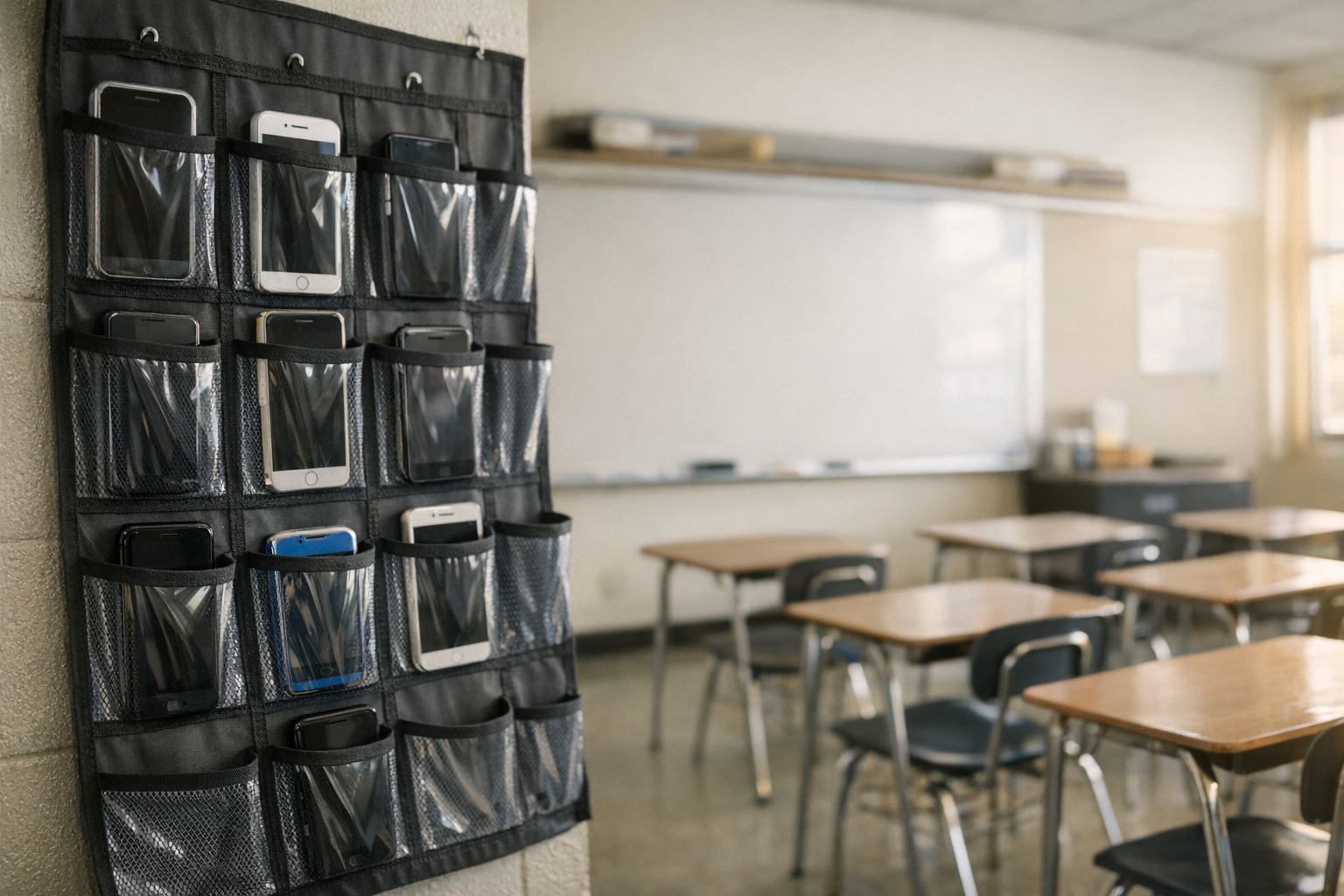
Illinois school leaders now have a statewide deadline to turn phone fights into policy. On July 28, Gov. JB Pritzker signed Senate Bill 2427 into law as Public Act 104-0657, requiring every local school board and charter school in Illinois to adopt a wireless-communication-device policy by the beginning of the 2027-28 school year. (my.ilga.gov)
The new law is broader and more specific than the shorthand “cellphone ban” suggests. It defines “school time” as the regular day from student arrival to dismissal, including instructional time, recess, lunch, and passing periods, and it covers not just phones but also tablets, laptops, gaming devices, and most wearables. It does not cover devices a district or teacher has issued or required for educational use. (ilga.gov)
What changed immediately is not what students do this fall, but what districts have to build next. The act took effect upon signing, requires local policies and administrative responses to be published in student handbooks if a handbook exists, and directs the Illinois State Board of Education to post a model wireless-device policy by Sept. 1, 2026. Districts then have roughly a year to settle storage, exceptions, discipline language, and family communication before the 2027-28 school year begins. (legiscan.com)
More than a ban, a state framework
Illinois did not simply order districts to “ban phones” and leave the rest to principals. The enrolled law says local policies must include guidance for storing devices inside school buildings during school time, emphasize uniform enforcement across each school, and handle implementation in a trauma-informed and developmentally appropriate way. It also says that if a school requires a parent or guardian to retrieve a device, the policy must offer an alternative when that adult cannot appear in person. (ilga.gov)
That detail matters because it shifts the work from slogans to operations. A district can no longer rely on a teacher-by-teacher understanding that phones are “not allowed in class.” It now needs an actual system: where devices go, who monitors them, what happens on a first or third violation, and how the school avoids making enforcement harsher for families who cannot leave work in the middle of the day. The law’s liability language reinforces that this is expected to be a hands-on process; bill summaries say school boards, charter governing bodies, and staff are immune from liability for damage to a device when it is stored in good faith under the policy. (legiscan.com)
The state also wrote in guardrails around exceptions. Official bill summaries and Capitol News Illinois reporting say districts must allow device use for health-management needs, special-education accommodations such as IEP or Section 504 requirements, emergencies or imminent threats, and English-learner access to learning materials. Districts may also choose additional flexibility, including whether “school time” for high school students excludes lunch and passing periods. (my.ilga.gov)
That last point is likely to be one of the biggest local fault lines. A statewide rule now exists, but Illinois still leaves room for very different high school models. Districts can move toward true bell-to-bell restrictions, or they can preserve some access outside class. The law does not settle that debate for them; it forces them to have it in public and put the answer in writing. (ilga.gov)
The discipline limits are also unusually explicit. The enrolled bill summary says schools may not enforce the wireless-device policy through fees, fines, suspensions, expulsions, or the deployment of a school resource officer or local law enforcement officer for the device-policy violation itself. That is a notable departure from policies that leave consequences almost entirely to local discretion, and it will constrain districts that might otherwise have folded phone violations into broader exclusionary discipline systems. (legiscan.com)
The hardest work is local
Illinois educators looking for a preview of what this could look like in practice can already see one version at Evanston Township High School, where classrooms are phone-free during class blocks and students are expected to store phones until the bell rings, but may use them during passing periods, lunch blocks, and free blocks. That arrangement closely resembles the kind of high-school flexibility the new law still permits districts to choose.
For school leaders, that means the real implementation questions are less ideological than logistical. Will devices stay in classroom holders, locked pouches, lockers, or backpacks? Who is responsible when a phone is missing or cracked? How will staff handle students who need a device for medical reasons without forcing them to repeatedly prove it? And if a district wants lunch-period access at the high school level, how will it keep that exception from swallowing the rule during passing periods and in the minutes before class starts? The statute provides a framework, but not a turnkey operating plan. (ilga.gov)
There is also a timing wrinkle that could soften the immediate impact in some places. According to the enrolled bill summary, districts and charter schools that already had a policy in place before the law took effect and that limited wireless devices during most or all of the day may keep that existing policy through the 2030-31 school year, then align with the new state requirements. In other words, Illinois has created a floor, but not every district will start from the same place. (legiscan.com)
That grandfather clause is especially relevant for districts that already invested in classroom storage, parent messaging, and staff training. For them, the work may be less about inventing a rule than about checking whether current practice matches the state’s required exceptions, publication rules, and discipline limits. Districts without a mature policy, by contrast, now have to build both the rule and the culture that makes it enforceable. (legiscan.com)
A fast-moving trend, slower-moving evidence
Illinois is joining a national shift, but relatively late. The National Conference of State Legislatures said on July 15 that 42 states, Washington, D.C., and Puerto Rico had enacted legislation related to cellphone use in schools. A JAMA Pediatrics study published July 27, using policies in effect as of April 15, likewise found 42 jurisdictions with statewide laws or policies; Illinois was still among the holdouts at that point. (ncsl.org)
The policy momentum, though, is moving faster than the research consensus. A 2026 National Bureau of Economic Research paper on U.S. school phone bans implemented with lockable pouches found average effects on test scores were close to zero overall, with modest positive effects in high schools, especially in math, and small negative effects in middle schools. The same study found little evidence of changed attendance, classroom attention, or perceived online bullying, and reported that student well-being initially dipped before improving later. (nber.org)
That does not mean the Illinois law is misguided. It means district leaders should be careful about overpromising. The strongest case for the law, at least for now, is that it creates a common statewide expectation and prevents the messiest enforcement responses. Whether it produces better learning conditions in a given school will still depend on consistency, credibility with families, and the everyday mechanics of storage and exceptions. (legiscan.com)
The next date worth watching is Sept. 1, 2026, when ISBE is supposed to post its model policy. That template will not end the local arguments over lunch-period access, parent contact, or what counts as a reasonable consequence. But it will begin the part of this story that matters most to principals and teachers: whether Illinois districts can turn a statewide mandate into a routine that works from first bell to last dismissal. (legiscan.com)
More from Policy & Funding

Fifth Circuit restores Mississippi DEI law for schools and colleges
The appeals court lifted the injunction against H.B. 1193 and reassigned the case, putting the law back in effect while districts and campuses review training, hiring, and programming.
Supreme Court to hear magnet admissions case over proof in race-bias claims
The justices limited review to whether challengers to a race-neutral K-12 admissions policy must show group-wide disparate impact against the applicant pool, a technical question with big consequences for selective programs.
Some Maryland districts will miss the state’s AI policy deadline
The Oct. 22 mandate requires every school system to adopt local rules on AI use, privacy, academic integrity, procurement, and human oversight — but board calendars and review timelines are getting in the way.